
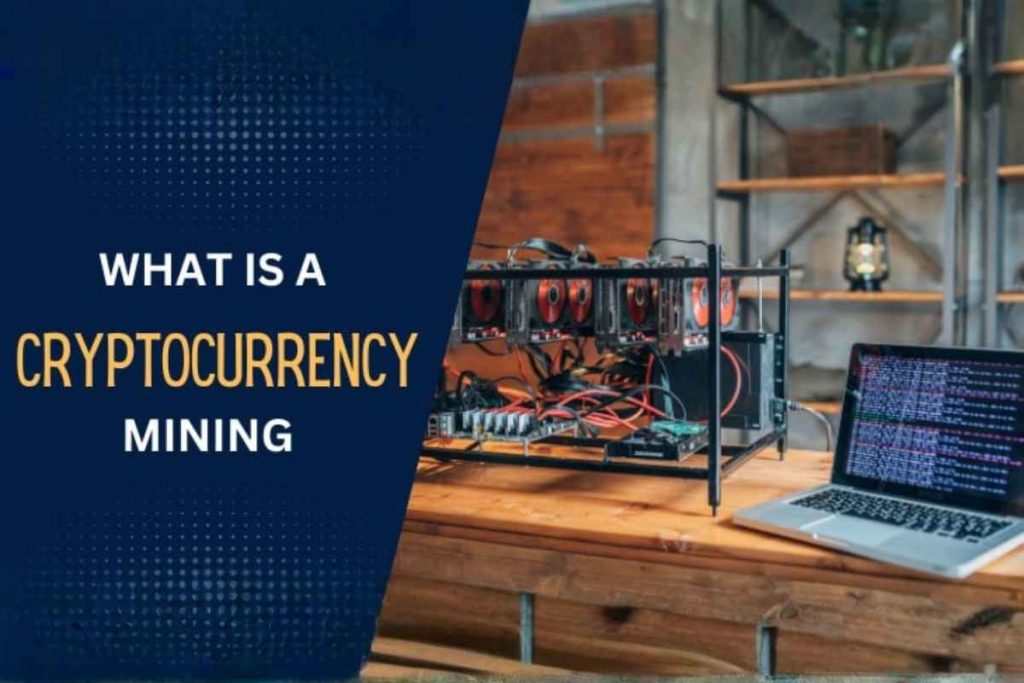
Cryptocurrency has become one of the most talked about financial topics in the world. But behind every Bitcoin transaction, there is a process called mining that makes it all work.
If you have ever wondered what cryptocurrency mining is, how it works, and whether it is worth getting into, this guide breaks it all down in simple, clear terms.
What Is Cryptocurrency Mining?
Cryptocurrency mining is the process of validating transactions on a blockchain network and adding them to a public digital ledger. Miners use powerful computers to solve complex mathematical puzzles. The first miner to solve the puzzle gets to add a new block to the blockchain and earns a reward in the form of newly minted cryptocurrency coins plus transaction fees.
Think of it like a global competition. Thousands of computers race to crack a code, and the winner gets paid in crypto. This process is what keeps networks like Bitcoin secure, decentralized, and fully functional without any central authority like a bank or government.
How Does Cryptocurrency Mining Work?
The mining process follows a clear sequence of steps:
- A user initiates a cryptocurrency transaction.
- The transaction is broadcast to a network of computers called nodes.
- Nodes bundle unverified transactions into a block.
- Miners compete to solve a cryptographic puzzle tied to that block.
- The first miner to find the correct solution shares it with the network.
- Other nodes verify the solution.
- The verified block is added to the blockchain.
- The winning miner receives newly created coins and transaction fees as a reward.
This entire process relies on a consensus mechanism called Proof of Work (PoW), which ensures that only verified miners can update the blockchain. It makes the network extremely difficult to hack or manipulate.
What Is a Hash and Why Does It Matter?
A hash is a fixed-length string of characters generated from transaction data using a mathematical function. Miners must find a specific hash value that meets the network’s requirements. Since they cannot predict the answer, they make billions of guesses per second until they find it. The speed at which a miner makes these guesses is called the hash rate, measured in hashes per second.
What Is Mining Difficulty?
Mining difficulty refers to how hard it is to find the correct hash. As more miners join the network, difficulty increases automatically to maintain a consistent rate of block production. For Bitcoin, a new block is added roughly every 10 minutes, and difficulty adjusts every 2,016 blocks, approximately every two weeks.
Types of Cryptocurrency Mining
There are several methods miners use depending on their budget, goals, and the cryptocurrency they want to mine.
| Mining Type | Hardware Used | Best For | Pros | Cons |
| CPU Mining | Computer processor | Beginner experiments | Low cost | Very slow, rarely profitable |
| GPU Mining | Graphics cards | Altcoins | Flexible, moderate power | Higher electricity costs |
| ASIC Mining | Dedicated mining chips | Bitcoin, Litecoin | Highest hash rate | Expensive, inflexible |
| Cloud Mining | Rented remote hardware | Passive miners | No hardware needed | Contract risks, lower returns |
| Mining Pool | Combined resources | All types | Higher, steadier income | Pool fees apply |
ASIC Mining
Application Specific Integrated Circuits (ASICs) are purpose built machines designed only for mining specific cryptocurrencies. They deliver the highest hash rates and are the standard for Bitcoin mining today. However, they are expensive and become obsolete as difficulty increases.
GPU Mining
Graphics Processing Units (GPUs) are more flexible than ASICs. They can mine multiple types of cryptocurrencies and are a popular choice for miners who want to switch between coins based on profitability. GPU rigs can achieve between 10 and 60 megahashes per second.
Cloud Mining
Cloud mining lets you rent mining power from large facilities without buying or managing any hardware. You pay a fee and receive a share of the profits. While it sounds convenient, contracts often favor the service provider, so research is essential before committing.
Mining Pools
Solo mining is extremely difficult today due to the sheer scale of global competition. Mining pools allow groups of miners to combine their computing power, increasing their chances of earning rewards. Earnings are then shared based on each miner’s contribution.
What Equipment Do You Need for Crypto Mining?
Getting started with mining requires several essential components:
- Mining hardware (ASIC miner or GPU rig)
- Mining software to connect your hardware to the network
- A reliable, high speed internet connection
- A crypto wallet to store your earnings
- Access to affordable electricity
Electricity is one of the biggest ongoing costs in crypto mining. The profitability of mining depends heavily on how much you pay per kilowatt hour and the current price of the cryptocurrency you are mining.
Must Read: 11 Easiest Crypto to Mine: Best Profitable Coins In Feb 2026
Cryptocurrencies You Can Mine
Not all cryptocurrencies use mining. Only those built on the Proof of Work model can be mined. Some popular mineable cryptocurrencies include:
- Bitcoin (BTC)
- Litecoin (LTC)
- Monero (XMR)
- Dogecoin (DOGE)
- Bitcoin Cash (BCH)
Ethereum (ETH) was previously mineable but switched to a Proof of Stake model in 2022, meaning it can no longer be mined.
Benefits and Risks of Cryptocurrency Mining
Benefits
- Earn cryptocurrency as a reward for contributing computing power
- Supports blockchain security and decentralization
- Provides passive income once set up properly
- Helps maintain the integrity of financial transactions without a central authority
Risks and Challenges
- High initial investment in hardware
- Rising electricity costs can eat into profits
- Mining difficulty increases over time, reducing returns
- Cryptocurrency prices are volatile, affecting profitability
- Environmental concerns due to massive energy consumption
Is Cryptocurrency Mining Profitable?
Profitability depends on several factors working in your favor at the same time. These include the current price of the cryptocurrency, your hardware efficiency, electricity costs, and the current mining difficulty. In Bitcoin’s early days, regular computers could mine profitably from home. Today, the landscape is dominated by large-scale mining farms that run hundreds of ASIC machines around the clock.
For individual miners, joining a mining pool and carefully calculating your break-even point before investing in hardware is the most sensible approach.
Conclusion
Cryptocurrency mining is a foundational process that keeps blockchain networks like Bitcoin running, secure, and decentralized. It rewards participants for contributing computing power while creating new coins and verifying transactions.
Whether you are curious about mining as a hobby or exploring it as a business, understanding how it works gives you a solid foundation to make smart decisions. Always calculate your costs carefully, stay informed about market conditions, and choose your mining method based on your resources and goals.

