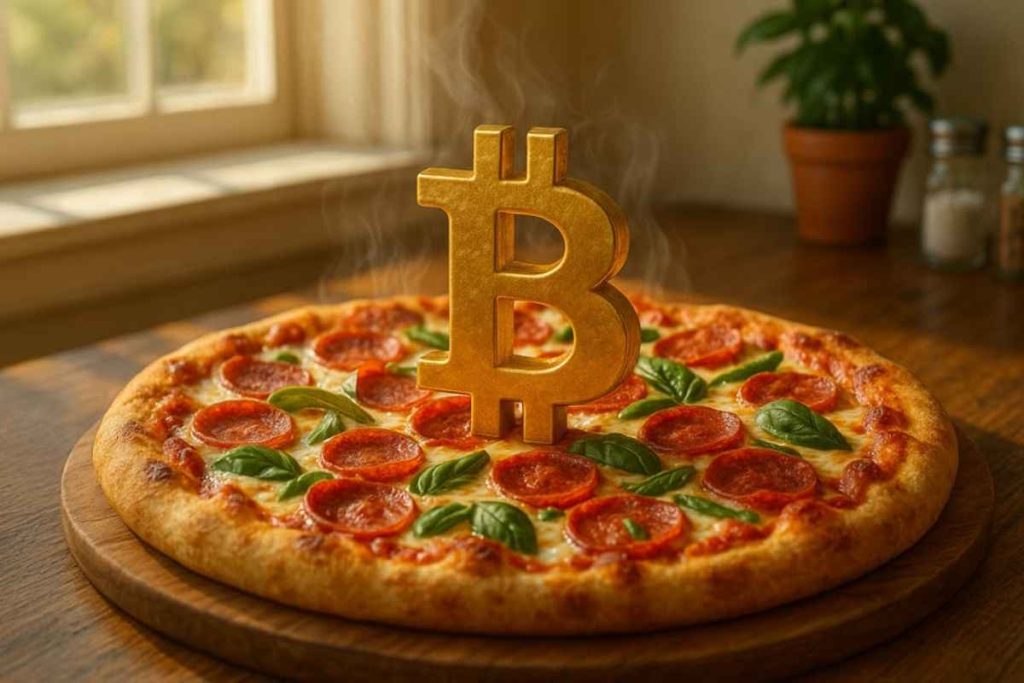
Imagine spending over a billion dollars on two pizzas. That is exactly what happened on May 22, 2010, when a Florida programmer named Laszlo Hanyecz paid 10,000 Bitcoin for two large Papa John’s pizzas. At the time, those coins were worth about $41. Today, that same amount of Bitcoin is valued at over one billion dollars.
This is the bitcoin pizza story, and it is one of the most talked-about moments in the entire history of cryptocurrency. It was not just a pizza order. It was the first time Bitcoin was used to buy something real in the physical world. That single transaction helped prove that digital currency could actually work as money.
Who Was Laszlo Hanyecz?
Laszlo Hanyecz was not just the man who bought pizza with Bitcoin. He was also a pioneer of Bitcoin’s early technical development, creating the first MacOS client for Bitcoin and discovering GPU mining. In the early days, most people ran Bitcoin software on regular home computers. Hanyecz pushed the boundaries further by using graphics processing units (GPUs) to mine Bitcoin faster than anyone else at that time.
He was active on the BitcoinTalk forum, the main online gathering place for early Bitcoin users, where he regularly contributed to discussions about the software. Despite all of this, the pizza story became his most famous moment in crypto history.
How the Bitcoin Pizza Transaction Happened
On May 18, 2010, Laszlo posted on BitcoinTalk offering 10,000 BTC for two large pizzas. He was not looking for the best deal. He simply wanted someone to accept Bitcoin in return for something real.
His exact words on the forum were casual and specific. He wanted large pizzas with toppings like onions, peppers, sausage, and pepperoni, and he made it very clear that he did not want any “weird fish topping.” He was open to someone either making the pizza themselves or ordering it for delivery.
For four days, nobody responded. Then on May 22, 2010, a 19-year-old student from California named Jeremy Sturdivant, known online as “jercos,” accepted the offer.
Jeremy did not pay with Bitcoin. Papa John’s did not accept it. Instead, he used his credit card to order two large pizzas for delivery to Laszlo’s home in Jacksonville, Florida. The total cost to Jeremy was about $25. Upon confirmation of delivery, Laszlo executed the transfer from his digital wallet, and the 10,000 Bitcoin moved across the blockchain to Jeremy.
The deal was done. Two pizzas in exchange for 10,000 Bitcoin. Hanyecz later posted photos of his family enjoying the meal, and the Bitcoin community celebrated what they called “a great milestone reached.”
The Key People Behind Bitcoin Pizza Day
| Person | Role | What Happened After |
| Laszlo Hanyecz | Bitcoin miner, buyer | Spent over 100,000 BTC total on pizza; no regrets |
| Jeremy Sturdivant | California student, seller | Spent his BTC on travel and games; sold at around $400 |
| Satoshi Nakamoto | Bitcoin creator | Remained anonymous; had warned Hanyecz about GPU mining |
What Made This Transaction So Important
Before May 22, 2010, Bitcoin had never been used to purchase a physical item. It existed only as a digital experiment passed between users on the internet. Nobody truly knew if it had real-world value or if it could function as a genuine currency.
The Bitcoin Pizza Day transaction is considered a seminal moment in Bitcoin’s history because it represented the first time the digital currency was used to purchase a physical item. It demonstrated that Bitcoin had a real-world value beyond just being traded between users.
This transaction accomplished several things at once. It created a market price for Bitcoin through a real exchange. It showed that peer-to-peer digital payments could actually work. And it gave the early Bitcoin community a story they could point to as proof that the system had practical use.
The transaction happened completely online. No banks, no credit cards, no PayPal. Just two people using the internet and trusting a protocol that was barely over a year old.
How Much Were Those Pizzas Worth Over the Years?
One of the most popular things people do on Bitcoin Pizza Day is calculate how much Laszlo’s 10,000 BTC would be worth at current prices. The growth is staggering.
| Year | Value of 10,000 BTC |
| 2010 | $41 |
| 2014 | $6,000,000 |
| 2017 | $100,000,000 |
| 2021 (ATH) | $690,000,000 |
| 2025 | Over $1,000,000,000 |
Hanyecz made similar trades multiple times, spending a total of 100,000 BTC on pizza in 2010. These early transactions helped demonstrate Bitcoin’s use case as a decentralized currency, paving the way for its mainstream adoption.
Did Laszlo Hanyecz Regret It?
This is the question everyone asks. The short answer is no.
Hanyecz has given multiple interviews over the years and consistently said he has no regrets. In his view, Bitcoin was designed to be used as peer-to-peer electronic cash. That is exactly what he did. At the time, no one could have predicted that Bitcoin would reach the prices it has today.
As he saw it, he committed culinary alchemy, transmuting his electricity and computing power into a cheap dinner. He had no idea that Bitcoin would command the price it does today, so the transaction was a victory in his book.
He later said in an interview: the purpose of Bitcoin was always to be used as money. He used it as money. That was the point.
What About Jeremy Sturdivant?
Jeremy “Jercos” Sturdivant is the other half of the story that often gets overlooked. He was only 19 years old when he accepted 10,000 BTC for two pizzas.
He later spent his 10,000 BTC, worth around $400 at the time he sold, on a road trip with his girlfriend. Like Laszlo, Jeremy did not hold onto his coins long-term. He did not regret it either. To him, it was a fun experiment using an interesting new internet currency.
Both men missed out on billions of dollars in hindsight. Yet both say they are proud to have played a role in Bitcoin history. Without someone willing to accept Bitcoin for something real, the cryptocurrency might have taken much longer to gain real-world credibility.
The Blockchain Record That Will Never Disappear
One remarkable aspect of this story is that the transaction is permanently visible on the Bitcoin blockchain. The expenditure recorded on the Bitcoin blockchain that financed the famous Pizza Day exchange was included in block 57,043. Hanyecz’s transaction was the only one in his block, in addition to the Coinbase transaction that paid the 50 BTC mining subsidy.
Anyone can look up the original transaction today using a blockchain explorer. This is one of the core features of Bitcoin. Every transaction is public, permanent, and tamper-proof. The pizza deal is not just a story. It is a piece of history written into a ledger that no one can erase.
How Bitcoin Pizza Day Is Celebrated Today
Every year on May 22, the global crypto community celebrates Bitcoin Pizza Day. It has grown far beyond a simple anniversary. Many pizza parlors now accept Bitcoin payments on that day. Crypto exchanges often run promotions. Online communities host discussions and events around the world.
Many members of the crypto community celebrate Bitcoin Pizza Day by ordering two pizzas to share, and market watchers note that Bitcoin trading volume increases on May 22.
In 2018, Laszlo Hanyecz went further. He made another Bitcoin pizza purchase, this time using the Lightning Network, a faster payment layer built on top of Bitcoin. This showed that he still believed in using Bitcoin as actual currency, not just holding it as an investment.
The Legacy of the Bitcoin Pizza Story
The bitcoin pizza story is more than just a funny “what if” tale about missing out on billions. It marks the moment Bitcoin stopped being a theoretical concept and started being real money.
Key takeaways from this story include:
- Bitcoin needed a real-world use case to gain credibility, and pizza provided it.
- Early adoption always carries risk, but it also drives innovation.
- The blockchain creates a permanent, trustless record of every transaction.
- Value is unpredictable. No one in 2010 imagined Bitcoin reaching six figures.
- Using money is not the same as wasting it. Laszlo used Bitcoin exactly as intended.
Bitcoin went from zero to over $100,000 per coin in roughly 15 years. That journey started with a pizza.
Conclusion
The bitcoin pizza story is one of the most powerful origin stories in the world of digital finance. A simple forum post, a willing teenager in California, two pizzas from Papa John’s, and 10,000 Bitcoin changed the course of cryptocurrency history. Laszlo Hanyecz proved that Bitcoin could be used as money. Jeremy Sturdivant proved that someone was willing to accept it. Together, they made May 22, 2010, a date that the crypto world will never forget.
Whether you view it as the world’s most expensive pizza or the best investment in proving Bitcoin’s value, one thing is certain. That meal cost $41 and kickstarted a trillion-dollar industry.