
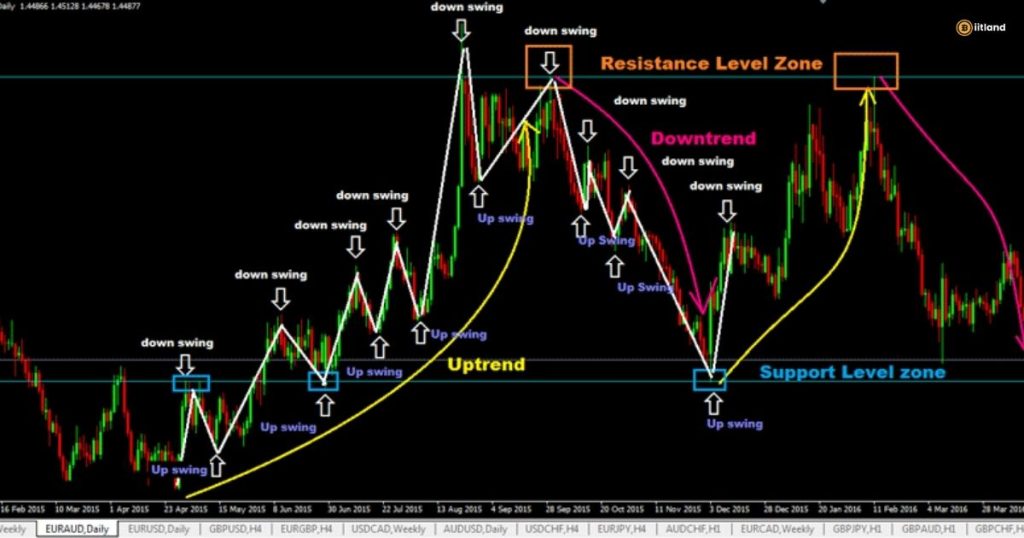
Swing trading is a forex trading strategy designed to capture short- to medium-term price movements within a larger market trend. Instead of opening and closing trades within the same day, swing traders usually hold positions for several days or even weeks to benefit from market momentum.
The main objective of swing trading is to profit from temporary market swings, pullbacks, and reversals that happen during broader bullish or bearish trends.
Table of Contents
ToggleKey Characteristics of Swing Trading
| Feature | Details |
|---|---|
| Trading Style | Medium-term trading |
| Holding Period | Several days to weeks |
| Main Analysis Method | Technical analysis |
| Popular Indicators | RSI, MACD, Moving Averages |
| Skill Requirement | Understanding of chart patterns and indicators |
How Swing Trading Works in Forex
Forex prices constantly move in waves. Even during a strong uptrend or downtrend, the market experiences temporary corrections and retracements.
A swing trader attempts to:
- Buy near short-term lows
- Sell near temporary highs
- Capture a portion of the market move
- Exit before momentum changes direction again
Unlike scalpers or day traders, swing traders focus on larger price movements instead of small intraday fluctuations.
Swing Trading vs Day Trading
| Swing Trading | Day Trading |
|---|---|
| Trades remain open for days or weeks | Trades close within the same day |
| Less screen time required | Requires constant chart monitoring |
| Targets larger price swings | Targets small intraday movements |
| Lower trading frequency | High-frequency trading |
| Suitable for part-time traders | Often preferred by full-time traders |
Why Swing Trading Works Well in Forex
The forex market is highly suitable for swing trading because of its:
- High liquidity
- Strong price volatility
- Tight spreads
- 24-hour market access during weekdays
Major currency pairs such as:
- EUR/USD
- GBP/USD
- USD/JPY
- NZD/USD
often create strong swing trading opportunities due to consistent market movement and technical setups.
Swing Trading Forex Example: NZD/USD
Consider the NZD/USD currency pair during a strong bearish trend. The New Zealand dollar continues weakening against the US dollar over several weeks.
A major support level around 0.6490 initially holds multiple times, preventing further decline. However, after repeated testing, the market finally breaks below this support zone and falls sharply toward 0.6300.
At this stage:
- The pair becomes heavily oversold
- Selling pressure begins slowing down
- The market starts consolidating near the lower price area
This creates a potential swing trading opportunity.
Understanding Support Levels in Swing Trading
A support level is a price area where buying interest becomes strong enough to slow or stop a downtrend.
Swing traders use support zones to:
- Identify possible market reversals
- Spot buying opportunities
- Plan low-risk trade entries
In the NZD/USD example, the support break followed by consolidation suggested that the market might experience a temporary rebound.
What Is Market Consolidation?
Consolidation occurs when price moves sideways after a strong trend. It often indicates:
- Reduced selling momentum
- Buyer and seller balance
- Potential upcoming breakout or reversal
Swing traders closely monitor consolidation zones because they can signal the beginning of a short-term upward move.
This is commonly known as:
“Buying the Dip”
Benefits of Swing Trading Forex
1. Flexible Trading Schedule
Swing trading is ideal for traders who cannot monitor charts all day.
2. Bigger Profit Potential
Trades target larger price moves compared to scalping.
3. Reduced Market Noise
Higher timeframes provide cleaner technical signals.
4. Better Risk Management
Swing traders usually have clearer stop-loss and target levels.
Important Technical Analysis Tools for Swing Traders
Successful swing traders commonly use:
- Relative Strength Index (RSI)
- Moving Averages
- Support and Resistance
- MACD Indicator
- Trendlines
- Candlestick Patterns
- Fibonacci Retracement
These indicators help traders identify:
- Trend direction
- Momentum strength
- Entry opportunities
- Exit levels
Importance of Discipline in Swing Trading
Emotional trading is one of the biggest reasons traders fail.
Professional swing traders follow strict rules regarding:
- Entry points
- Stop losses
- Profit targets
- Position sizing
- Risk management
Holding trades too long because of greed can quickly erase profits when the market reverses unexpectedly.
Risk Management Tips for Swing Traders
Proper risk control is essential for long-term success in forex trading.
Best Risk Management Practices
- Risk only 1–2% of trading capital per trade
- Always place a stop-loss order
- Avoid overleveraging
- Maintain a strong risk-to-reward ratio
- Never trade based purely on emotions
Consistent risk management often matters more than finding perfect entries.
FAQs
1. What is swing trading?
Swing trading is a strategy where traders hold trades for several days or weeks to profit from market price swings.
2. Is swing trading good for beginners?
Yes, swing trading is beginner-friendly because it requires less screen time than day trading.
3. Which forex pairs are best for swing trading?
Popular pairs include EUR/USD, GBP/USD, USD/JPY, and NZD/USD.
4. What indicators do swing traders use?
Swing traders commonly use RSI, Moving Averages, and Support & Resistance levels.
5. Can swing trading be profitable?
Yes, swing trading can be profitable with proper strategy, discipline, and risk management.
Final Thoughts
Swing trading forex is a powerful medium-term trading strategy that allows traders to profit from temporary market movements inside larger trends. By using technical analysis, support and resistance levels, and momentum indicators, swing traders can identify high-probability setups in volatile currency markets.
Although no trading strategy guarantees profits every time, disciplined execution, patience, and effective risk management can significantly improve long-term trading performance.

