Swing trading is a popular trading strategy that allows traders to profit from short-term price movements in financial markets without constantly monitoring charts throughout the day. Unlike day trading, where positions are usually closed within the same session, swing traders hold positions for several days or weeks to capture larger market moves.
This trading approach combines technical analysis, market trends, and risk management to identify potential buying and selling opportunities. In this guide, you will learn what swing trading is, how it works, common strategies, important indicators, advantages and risks, and how beginners can start developing a swing trading plan. Whether you are interested in stocks, cryptocurrencies, forex, or other markets, understanding swing trading can help you make more informed trading decisions.
What Is Swing Trading?
Swing trading is a trading style where traders attempt to capture short-term price changes by holding financial assets for a few days to several weeks.
The main goal is to identify market “swings” — upward or downward movements — and benefit from those price fluctuations.
Swing traders usually analyze:
- Price trends
- Chart patterns
- Market momentum
- Support and resistance levels
- Trading volume
- Technical indicators
Unlike long-term investors, swing traders focus on shorter market opportunities.
How Does Swing Trading Work?
Swing trading works by identifying potential entry and exit points based on market analysis.
A typical swing trading process includes:
- Finding a potential trading opportunity
- Analyzing price charts
- Identifying support and resistance levels
- Entering a trade
- Setting stop-loss protection
- Monitoring price movement
- Closing the position at a target level
The trader aims to capture a portion of a larger price movement rather than predicting every market change.
Swing Trading vs Day Trading
Swing trading and day trading are both short-term strategies, but they differ in execution and time commitment.
| Feature | Swing Trading | Day Trading |
| Holding Period | Days to weeks | Minutes to hours |
| Trading Frequency | Lower | Higher |
| Screen Time | Moderate | High |
| Strategy Focus | Market trends | Intraday movements |
| Stress Level | Usually lower | Usually higher |
| Capital Requirements | Often flexible | May require more capital |
| Analysis Style | Technical + fundamental | Mostly technical |
Swing trading may suit people who cannot watch markets all day.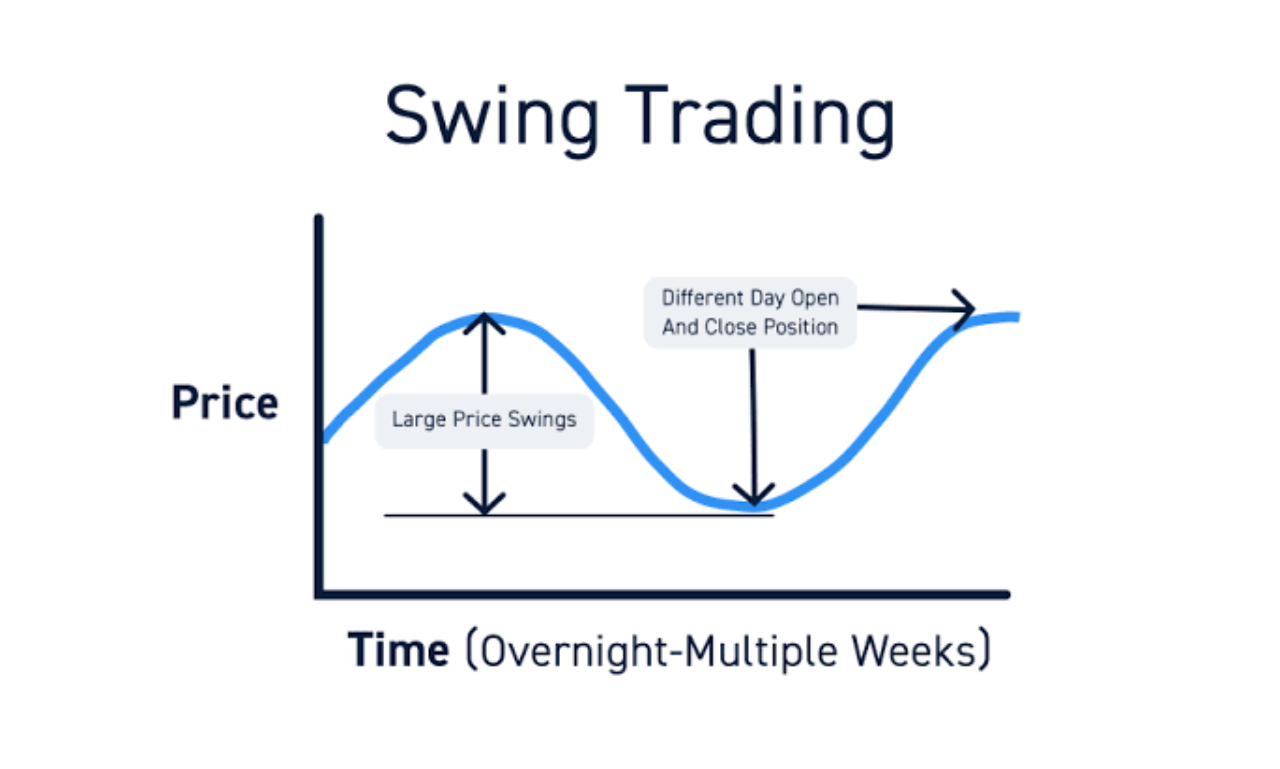
Key Characteristics of Successful Swing Trading
Successful swing traders usually follow a disciplined approach.
Important characteristics include:
- Patience
- Risk control
- Market research
- Trading discipline
- Emotional control
- Consistent strategy
- Proper position sizing
A successful swing trader focuses on probabilities rather than trying to predict every price movement.
Common Swing Trading Strategies
Traders use different strategies depending on market conditions.
Trend Following Strategy
This strategy involves trading in the direction of an existing market trend.
Example:
- Buying during an uptrend
- Selling during a downtrend
Traders often use moving averages and trend indicators to identify direction.
Breakout Trading Strategy
Breakout traders enter positions when prices move beyond important levels.
Common breakout signals:
- Breaking resistance levels
- Increasing trading volume
- Strong momentum movement
Pullback Trading Strategy
This strategy focuses on temporary price reversals within a larger trend.
Example:
- Buying after a temporary decline during an uptrend
- Selling after a temporary rise during a downtrend
Best Indicators Used in Swing Trading
Technical indicators help traders analyze market conditions.
Popular swing trading indicators include:
| Indicator | Purpose |
| Moving Average | Identifies trends |
| RSI | Measures momentum |
| MACD | Detects trend changes |
| Bollinger Bands | Shows volatility |
| Volume Indicators | Confirms price movements |
| Fibonacci Retracement | Finds potential support levels |
Indicators should support analysis rather than replace proper research.
Swing Trading in Different Markets
Swing trading can be applied across multiple financial markets.
Stock Market Swing Trading
Stocks are one of the most common markets for swing traders.
Traders analyze:
- Company performance
- Earnings reports
- Market trends
- Price patterns
Crypto Swing Trading
Cryptocurrency markets provide frequent price movements.
Crypto swing traders often analyze:
- Bitcoin trends
- Market sentiment
- Trading volume
- Support and resistance
Forex Swing Trading
Forex swing traders focus on currency pair movements.
Common factors include:
- Economic reports
- Interest rates
- Global events
- Currency strength
Benefits of Swing Trading
Swing trading offers several advantages compared with other trading styles.
Benefits include:
- Less screen time compared with day trading
- Opportunity to capture larger price moves
- Suitable for part-time traders
- Lower trading frequency
- More time for analysis
- Flexible trading schedule
Many professionals use swing trading because it balances opportunity and time commitment.
Risks and Challenges of Swing Trading
Although swing trading can be profitable, it also carries risks.
Common challenges include:
- Market volatility
- Unexpected news events
- Overnight price gaps
- Emotional decisions
- Incorrect analysis
- Poor risk management
Traders should never risk money they cannot afford to lose.
How Beginners Can Start Swing Trading
Beginners should build knowledge before risking real capital.
Recommended steps:
- Learn basic market concepts
- Understand technical analysis
- Practice with paper trading
- Create a trading plan
- Start with small positions
- Track trading results
- Improve strategies gradually
A structured approach helps reduce unnecessary mistakes.
Risk Management Rules for Swing Traders
Risk management is one of the most important parts of trading success.
Important rules include:
- Use stop-loss orders
- Avoid over-leveraging
- Limit position sizes
- Diversify trades
- Maintain realistic expectations
- Keep trading records
Protecting capital should always be the first priority.
Future of Swing Trading in 2026
Technology continues changing how traders analyze markets.
Future trends include:
- AI-powered market analysis
- Automated trading tools
- Advanced charting platforms
- Real-time market alerts
- Better educational resources
- Improved trading analytics
Technology may make market analysis faster, but human decision-making remains important.
Frequently Asked Questions:
What is swing trading in simple terms?
Swing trading is a strategy where traders hold assets for days or weeks to profit from short-term price movements.
How long do swing traders hold positions?
Most swing traders hold positions from several days to a few weeks, depending on market conditions.
Is swing trading good for beginners?
Swing trading can be suitable for beginners because it requires less screen time than day trading.
What markets can be used for swing trading?
Swing trading is commonly used in stocks, cryptocurrencies, forex, ETFs, and commodities.
Is swing trading safer than day trading?
Swing trading may involve less stress, but it still carries financial risks and requires proper risk management.
Do swing traders use technical analysis?
Yes, most swing traders use technical analysis, chart patterns, and indicators to identify opportunities.
Can swing trading be done part-time?
Yes, many people choose swing trading because it does not require watching markets all day.
How much money is needed for swing trading?
The required capital depends on the market, broker rules, and individual trading strategy.
What is the best indicator for swing trading?
Popular indicators include moving averages, RSI, MACD, and volume analysis.
Can swing trading be profitable?
Swing trading can be profitable, but success depends on strategy, discipline, market knowledge, and risk management.
Conclusion
Swing trading is a flexible trading approach that allows investors to take advantage of short-term market movements while avoiding the constant monitoring required in day trading. By using technical analysis, proper risk management, and disciplined strategies, traders can identify potential opportunities across stocks, crypto, forex, and other markets.
However, swing trading is not a guaranteed way to make profits. Successful traders focus on learning, testing strategies, managing risk, and controlling emotions. For beginners, starting with education and paper trading can provide valuable experience before using real money. With the right approach, swing trading can become an effective part of a broader trading strategy in 2026.