
Bitcoin mining is the foundation that keeps the Bitcoin network secure, decentralized, and operational. It allows transactions to be verified while introducing new bitcoins into circulation through a process called proof-of-work. Understanding how does bitcoin mining work step by step helps beginners learn how miners use powerful computers, cryptographic algorithms, hashes, and specialized hardware to solve complex challenges. The process involves creating blocks, finding valid hashes, and maintaining the blockchain without relying on a central authority. From mining rewards and ASIC machines to network difficulty and mining pools, Bitcoin mining combines technology and economics to support the world’s largest cryptocurrency ecosystem.
Key Takeaways
Bitcoin mining may seem complicated at first, but the basic idea is straightforward: miners use specialized computers to secure the network and confirm Bitcoin transactions. The mining process follows specific rules that allow thousands of independent participants to work together without a central authority.
The most important points beginners should understand include:
- Bitcoin mining verifies and records transactions on the blockchain.
- Miners compete to solve a cryptographic puzzle using powerful computers.
- The solution requires finding a valid hash that meets the network’s target hash requirement.
- A miner who successfully creates a new block receives mining rewards.
- Bitcoin uses a proof-of-work system to prevent fraud and protect the network.
- Mining difficulty changes automatically depending on the network’s total mining capacity.
- Modern Bitcoin mining requires specialized hardware called application-specific integrated circuits (ASICs).
Bitcoin mining is not simply about creating new coins. Its main purpose is maintaining trust in a decentralized financial system. Every confirmed block strengthens the blockchain by creating a permanent record of transactions that cannot easily be changed.
What Is Bitcoin Mining?
Bitcoin mining is the process of using computer power to verify transactions, add them to the Bitcoin blockchain, and release new bitcoins into circulation. It is an essential part of the Bitcoin network because it replaces the need for a central authority such as a bank or government institution.
When users send bitcoin to each other, those transactions are grouped together with other pending transactions. Miners collect these transactions and organize them into a potential new block. However, before a block can become part of the blockchain, miners must solve a complex mathematical challenge using a cryptographic algorithm.
This challenge involves generating a specific type of hash. A hash is a unique digital fingerprint created by a hash function. Bitcoin uses the SHA256 generator, which converts transaction data into a 64-digit hexadecimal number. Miners repeatedly change a small piece of information called a nonce until they discover a hash that satisfies Bitcoin’s difficulty rules.
The mining process serves two major purposes:
- Transaction verification:
Miners confirm that Bitcoin transactions are legitimate and prevent problems such as double spending, where someone attempts to use the same bitcoin twice. - New bitcoin creation:
Mining introduces new bitcoins into circulation through block rewards given to successful miners.
Unlike traditional money printing, Bitcoin creation follows strict rules. The total supply is limited to 21 million bitcoins, and the amount miners receive decreases over time through Bitcoin halving events.
Fast Fact
Bitcoin mining does not involve physically creating coins. Instead, miners earn digital rewards by using computational power to secure the network. Every Bitcoin block contains verified transaction data, a timestamp, and information required to connect it securely to previous blocks on the blockchain.
The word “mining” is used because the process is similar to extracting valuable resources. However, instead of digging underground, miners search through trillions of possible calculations to find a valid cryptographic solution.
How the Bitcoin Mining Process Works
The Bitcoin mining process follows a series of technical steps that allow the network to operate without a central organization. Every miner in the network follows the same protocol rules, ensuring fairness and security.
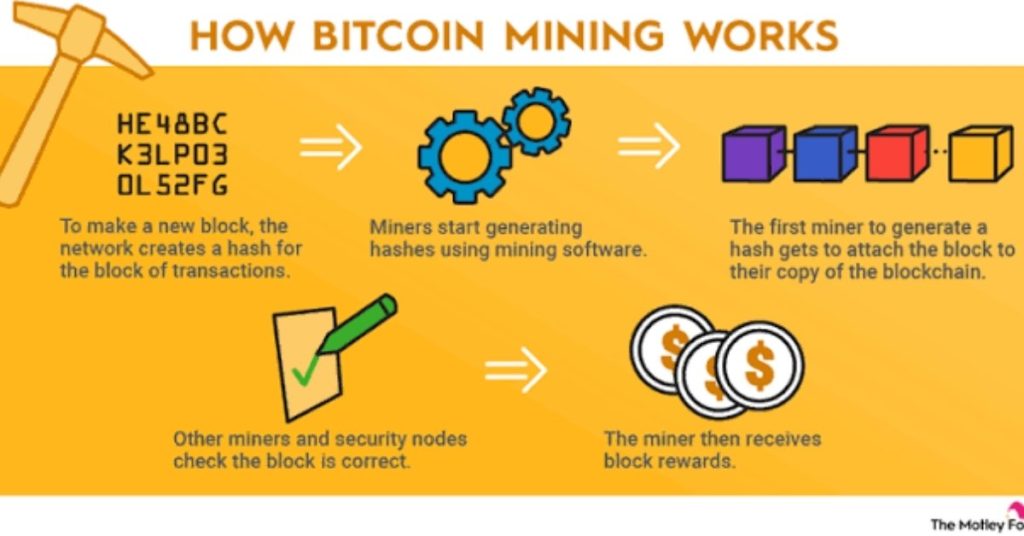
The Bitcoin mining process works through these main stages:
- Transactions are broadcast to the network
When someone sends bitcoin, the transaction is shared with the Bitcoin network. Computers called nodes verify whether the transaction follows Bitcoin’s rules, such as checking digital signatures and ensuring the sender has enough bitcoin. - Transactions are collected into a block
Valid transactions waiting for confirmation are placed into a temporary group called a block. Miners select these transactions and prepare them for verification. - Miners create a block header
Each block contains important information, including:- Previous block hash
- Transaction data
- Timestamp
- Difficulty target
- Nonce value
- The block header is the information miners process through the hashing algorithm.
- Miners compete to find the correct hash
Using powerful mining hardware, miners calculate billions or trillions of hashes every second. They adjust the nonce repeatedly until they find a hash that meets the required target. - The successful miner adds the block
When a miner discovers a valid solution, the block is broadcast to the network. Other Bitcoin participants verify the solution. If everything is correct, the block becomes permanently added to the blockchain. - The miner receives rewards
The successful miner receives a block reward consisting of newly created bitcoins and transaction fees from included transactions.
The mining process is designed so that finding a solution is difficult, but verifying the solution is easy. This balance allows Bitcoin to remain secure while allowing millions of transactions to be processed globally.
Important
The Bitcoin mining process is based on proof-of-work, meaning miners must prove that they have completed computational work before adding new blocks. This prevents attackers from easily changing transaction history because altering the blockchain would require enormous amounts of computing power.
The network automatically adjusts mining difficulty approximately every two weeks. If more miners join and increase the network’s total mining capacity, the difficulty increases. If miners leave, the difficulty decreases.
This automatic adjustment keeps Bitcoin’s block creation rate close to one block every 10 minutes, regardless of changes in mining activity.
The Hash
A hash is one of the most important concepts in understanding how Bitcoin mining works. It is a unique output created when information passes through a cryptographic algorithm.
Bitcoin uses the SHA256 cryptographic algorithm to generate hashes. The result is always a 64-digit hexadecimal number made up of numbers and letters from A to F. Unlike a normal calculation, a hash function works in only one direction. This means it is easy to create a hash from information, but almost impossible to reverse the process and discover the original data.
For example, if a miner enters transaction information into the SHA256 generator, it produces a specific hash. Even a tiny change in the original information creates a completely different result.
A Bitcoin hash has several important characteristics:
- It is always the same length.
- It cannot be predicted before calculation.
- Changing any small detail creates a new hash.
- It helps protect the blockchain from manipulation.
Miners are not solving a traditional mathematical equation. Instead, they are searching for a hash that meets the network’s requirements. Since there is no shortcut, miners must perform countless attempts every second.
Modern Bitcoin mining operations use ASIC machines because ordinary computers cannot compete with the massive computational power required today. These specialized devices are designed specifically for Bitcoin’s hashing process.
The higher a miner’s hash rate, the more calculations their equipment can perform per second. A higher hash rate increases the chance of finding the correct block solution before competitors.
Understanding hashes explains why Bitcoin mining requires significant hardware investment, electricity consumption, and technical resources. The entire security model of Bitcoin depends on this computational competition.
Target Hash and Nonce
The target hash is one of the most important elements in the Bitcoin mining process because it determines whether a miner’s block solution is accepted by the network. Bitcoin does not allow miners to create any random hash and add a block. The generated hash must be lower than or equal to a specific value known as the target hash.
The target hash is controlled by Bitcoin’s difficulty rules. The network automatically adjusts this target approximately every 2,016 blocks, which is around every two weeks. This adjustment ensures that new blocks continue to be created at a predictable rate, even when more miners join or leave the network.
A lower target hash means mining becomes more difficult because miners have fewer possible hashes that meet the requirement. A higher target hash makes mining easier because more possible solutions become acceptable.
To find a valid hash, miners use a number called a nonce, which means “number only used once.” The nonce is a value inside the block header that miners repeatedly change while running the SHA256 generator.
The mining process works like this:
- A miner creates a block containing verified Bitcoin transactions.
- The block information is converted into a hash.
- The miner changes the nonce value.
- The computer generates another hash.
- The process repeats until a valid hash below the target hash is discovered.
The nonce field has a limit of around 4.5 billion possible values because it uses a 32-bit number. Since modern mining hardware can test billions of possibilities quickly, miners often use an additional value called an extra nonce inside the coinbase transaction field to create even more possible combinations.
This constant search explains why Bitcoin mining requires enormous computing power. Mining machines across the world generate trillions of hashes per second while competing to discover the correct solution first.
Hash Example
To better understand hashing, imagine entering a simple phrase into a SHA256 generator. A phrase like “Hello World!” creates a unique 64-digit hexadecimal number. If even one letter or space changes, the entire hash output changes completely.
For example:
- Input: Hello World!
- Output: A unique 64-digit hexadecimal hash
If a miner changes one small part of the block information, such as the nonce, the resulting hash becomes completely different. The miner has no way to predict which nonce will create the correct hash, so the only option is to keep trying different combinations.
Bitcoin mining depends on this trial-and-error process. The network does not reward miners for being close to the answer. A hash either meets the target requirement or it does not.
The number of possible combinations is extremely large. The hexadecimal system uses 16 symbols:
- Numbers: 0–9
- Letters: A, B, C, D, E, F
Because Bitcoin hashes contain 64 hexadecimal characters, there are an enormous number of possible combinations. The possibilities are so large that they are measured using extremely high numerical terms, including figures such as 1.1579 novemvigintillion, which represents a number with many zeros.
This massive search space protects Bitcoin from attacks. If someone wanted to change a previous transaction, they would need to recreate the hashes for that block and every block added afterward while competing against the entire Bitcoin network.
Read More : Cardano (ADA) vs Bitcoin: Key Differences You Must Know
The hash system creates a secure digital fingerprint for every block and ensures that Bitcoin’s blockchain remains accurate and resistant to manipulation.
The Mining of Block 490163
Block 490163 is often used as an example to explain how Bitcoin mining works in real-world conditions. Like every Bitcoin block, it required miners to compete by generating hashes until one participant discovered a valid solution.
When miners work on a block, they are not randomly creating bitcoins. They are verifying transactions and adding another permanent record to the blockchain. Each block contains transaction details, a reference to the previous block, and the cryptographic information needed to maintain the chain.
The mining of a block follows the same general process:
- Thousands of pending Bitcoin transactions are collected.
- Miners organize selected transactions into a block.
- Mining hardware calculates hashes repeatedly.
- A miner discovers a hash that satisfies the target requirement.
- The network verifies the solution.
- The block becomes part of the blockchain.
The successful miner receives the block reward for completing the work. This reward acts as an incentive for miners to provide security to the network.
The example of Block 490163 demonstrates how competitive Bitcoin mining has become. In the early years of Bitcoin, individuals could mine using standard computers. Today, professional mining operations use large facilities filled with ASIC machines because the competition requires specialized equipment and significant energy resources.
The process remains the same, but the scale has changed dramatically. Modern miners operate with advanced hardware capable of producing billions or trillions of hashes per second.
Why Bitcoin Needs Miners
Bitcoin needs miners because they perform the essential work of securing the network and confirming transactions. Without miners, Bitcoin would not have a reliable way to verify payments or maintain its decentralized structure.
Traditional financial systems rely on banks and payment processors to confirm transactions. Bitcoin replaces this centralized authority with a global network of miners and nodes working together.
Miners provide several important functions:
- Transaction verification:
Miners confirm that transactions are valid before adding them to the blockchain. - Network security:
The computational effort required for mining makes it extremely difficult for attackers to alter past transactions. - Blockchain maintenance:
Miners continuously add new blocks, keeping the public transaction record updated. - New bitcoin distribution:
Mining introduces new bitcoins into circulation according to Bitcoin’s programmed supply schedule.
The security of Bitcoin comes from the amount of computational power protecting the network. An attacker attempting to rewrite transaction history would need to control a majority of the network’s mining power, commonly known as a 51% attack.
As more miners participate, the network becomes stronger because changing the blockchain requires more resources. This creates a system where security is supported by economic incentives.
Bitcoin miners are also important because they help maintain trust in a decentralized currency. Every confirmed block represents agreement among network participants that transactions follow Bitcoin’s rules.
Why Mine Bitcoin?
Many people choose to mine Bitcoin because of the potential financial rewards and the opportunity to participate in maintaining the world’s largest cryptocurrency network. However, Bitcoin mining is no longer as simple as running software on a personal computer.
Today, successful mining requires careful planning, powerful hardware, affordable electricity, and knowledge of mining economics.
The main reasons people mine Bitcoin include:
- Mining rewards:
Miners receive bitcoins and transaction fees when they successfully add new blocks. - Participation in cryptocurrency technology:
Mining allows individuals and companies to contribute to Bitcoin’s decentralized system. - Long-term investment potential:
Some miners believe holding mined bitcoins may provide future value. - Business opportunities:
Large-scale mining companies operate professional facilities dedicated to cryptocurrency mining.
Important
Bitcoin mining profitability depends on several factors, including:
- Bitcoin’s market price
- Electricity costs
- Mining hardware efficiency
- Network difficulty
- Mining rewards
- Operational expenses
Bitcoin halving events also affect mining economics. Approximately every four years, the reward for mining a new block is reduced by half. This decreases the number of new bitcoins entering circulation and changes the potential income miners receive.
For many beginners, directly purchasing Bitcoin through a cryptocurrency exchange may be simpler than mining. Mining requires substantial hardware investment and technical knowledge, while buying bitcoin allows users to gain exposure without managing mining equipment.
Professional miners often join a cryptocurrency mining pool, where multiple miners combine their computing power. Rewards are distributed among participants based on their contribution to the pool’s total hash rate.
Mining remains a critical part of Bitcoin, but it has evolved from a hobby for individuals into a highly competitive industry requiring significant time and capital investment.
How Long Does It Take to Mine 1 Bitcoin?
The time required to mine 1 Bitcoin depends on several factors, including mining hardware, total network difficulty, electricity costs, and whether a miner works independently or participates in a mining pool. There is no fixed amount of time that guarantees the creation of one bitcoin because miners do not individually mine specific coins. Instead, they compete to discover blocks, and the reward is shared according to the rules of the Bitcoin network.
Bitcoin’s protocol is designed so that a new block is added to the blockchain approximately every 10 minutes. When a miner successfully creates a block, they receive the current block reward along with transaction fees. However, this reward is paid for the entire block, not for mining one individual bitcoin.
The amount of bitcoin generated from each block changes over time because of Bitcoin halving events. These events reduce mining rewards by 50%, making new bitcoins increasingly scarce.
Several factors influence how quickly a miner can earn bitcoin:
- Mining hardware power:
More advanced ASIC machines can perform more calculations per second, increasing the chance of earning rewards. - Hash rate:
A miner’s hash rate determines how many possible solutions their equipment can attempt every second. - Network difficulty:
When more miners compete, Bitcoin automatically increases difficulty to maintain the regular block creation schedule. - Electricity expenses:
Mining requires significant energy, and high electricity costs can reduce profitability. - Mining pool participation:
Individual miners often join pools to receive smaller but more consistent payments instead of waiting years for a solo mining reward.
For example, a single modern ASIC miner may contribute only a small percentage of the total Bitcoin network hash rate. Because thousands of mining machines compete globally, solo miners have a very low chance of discovering an entire block by themselves.
In the early years of Bitcoin, individuals could mine using regular computers and earn significant amounts of bitcoin. Today, mining has become a specialized industry dominated by companies operating large-scale facilities with hundreds or thousands of ASIC machines.
Therefore, the question “how long does it take to mine 1 Bitcoin?” does not have one simple answer. The realistic timeframe depends on the miner’s computing power, network conditions, and overall mining strategy.
What You Need to Mine Bitcoin
Bitcoin mining requires specialized equipment, technical knowledge, and financial resources. While anyone can participate in the Bitcoin network, profitable mining today requires much more than installing mining software on a computer.
The basic requirements for Bitcoin mining include:
1. Application-Specific Integrated Circuits (ASICs)
Modern Bitcoin mining relies on application-specific integrated circuits, commonly called ASICs. These devices are built specifically to perform Bitcoin’s hashing calculations efficiently.
Unlike general-purpose computers, ASIC miners are designed only for cryptocurrency mining. They provide significantly higher hash rates while using less energy compared with traditional computer hardware.
Important features of ASIC miners include:
- High processing speed
- Specialized Bitcoin mining design
- Improved energy efficiency
- Ability to perform trillions of hashes per second
Because mining difficulty has increased significantly, older hardware often cannot compete with modern equipment.
2. Reliable Electricity Supply
Electricity is one of the biggest expenses in Bitcoin mining. Mining machines operate continuously and consume large amounts of power.
Read More : What Is Decentralized Finance? A Complete DeFi Guide
Miners often search for locations with:
- Low electricity prices
- Stable energy supply
- Proper cooling systems
- Reliable infrastructure
Large mining operations may build facilities near affordable energy sources to reduce operating costs.
3. Mining Software
Mining hardware needs software to communicate with the Bitcoin network. Mining software connects the ASIC machine to the blockchain, manages mining activity, and allows miners to join mining pools.
The software helps miners:
- Receive mining tasks
- Submit completed hashes
- Monitor performance
- Track earnings
4. Bitcoin Wallet
Miners need a Bitcoin wallet to receive mining rewards. A wallet stores the private keys needed to access bitcoin holdings.
Different types of wallets include:
- Hardware wallets
- Software wallets
- Mobile wallets
- Desktop wallets
Security is extremely important because losing wallet access can permanently prevent users from accessing their bitcoin.
5. Mining Pool Membership
Most individual miners join a mining pool because solo mining is extremely difficult. A mining pool combines the computing power of many participants, increasing the chance of successfully mining blocks.
When the pool earns rewards, payments are distributed among members based on their contributed hash rate.
Mining pools provide:
- More predictable income
- Lower reward uncertainty
- Easier participation for smaller miners
However, pools usually charge a small fee for providing their services.
6. Time and Capital Investment
Bitcoin mining requires both financial investment and Ongoing Management. Miners must consider:
- Hardware purchase costs
- Electricity bills
- Maintenance expenses
- Cooling requirements
- Bitcoin market conditions
Successful mining is not guaranteed. Profitability changes as Bitcoin prices, mining difficulty, and operational costs change.
Frequently Asked Questions (FAQs)
How does Bitcoin mining work step by step?
Bitcoin mining works by collecting pending transactions, creating a block, generating hashes through the SHA256 algorithm, finding a valid nonce that produces a hash below the target hash, and adding the approved block to the blockchain. The successful miner receives mining rewards in return for securing the network.
What is Bitcoin mining in simple terms?
Bitcoin mining is the process of using powerful computers to verify transactions and maintain the Bitcoin blockchain. Miners compete to solve cryptographic problems, and successful participants earn bitcoin rewards.
Why does Bitcoin need miners?
Bitcoin needs miners to confirm transactions, prevent fraud, maintain blockchain security, and create new bitcoins according to the network’s programmed rules.
Can anyone mine Bitcoin?
Technically, anyone can mine Bitcoin, but profitable mining requires specialized ASIC hardware, affordable electricity, and technical knowledge. Most individual miners today join cryptocurrency mining pools because competing alone is extremely difficult.
What hardware is used for Bitcoin mining?
Bitcoin mining primarily uses application-specific integrated circuits (ASICs). These machines are designed specifically for Bitcoin’s hashing process and provide much higher performance than ordinary computers.
Is Bitcoin mining still profitable?
Bitcoin mining profitability depends on factors such as electricity costs, hardware efficiency, Bitcoin price, network difficulty, and mining rewards. Some large-scale operations remain profitable, while individual miners may struggle without access to affordable resources.
What happens when all Bitcoin is mined?
Bitcoin’s maximum supply is limited to 21 million coins. Once all bitcoins are mined, miners will no longer receive new bitcoin rewards but will continue earning transaction fees for processing and securing transactions.
Final Words
Bitcoin mining is the process that secures the Bitcoin network, verifies transactions, and introduces new bitcoins into circulation. Miners use powerful computers and specialized ASIC hardware to solve cryptographic puzzles by finding a valid hash that meets the network’s target requirements. The process involves blockchain technology, hashing, nonces, mining difficulty, and proof-of-work mechanisms that keep Bitcoin decentralized and secure.
Mining Bitcoin requires significant hardware investment, electricity, and technical knowledge. While rewards can be attractive, profitability depends on factors like Bitcoin price, network difficulty, and operational costs. Understanding the mining process helps beginners see how Bitcoin maintains trust without relying on traditional financial institutions.

