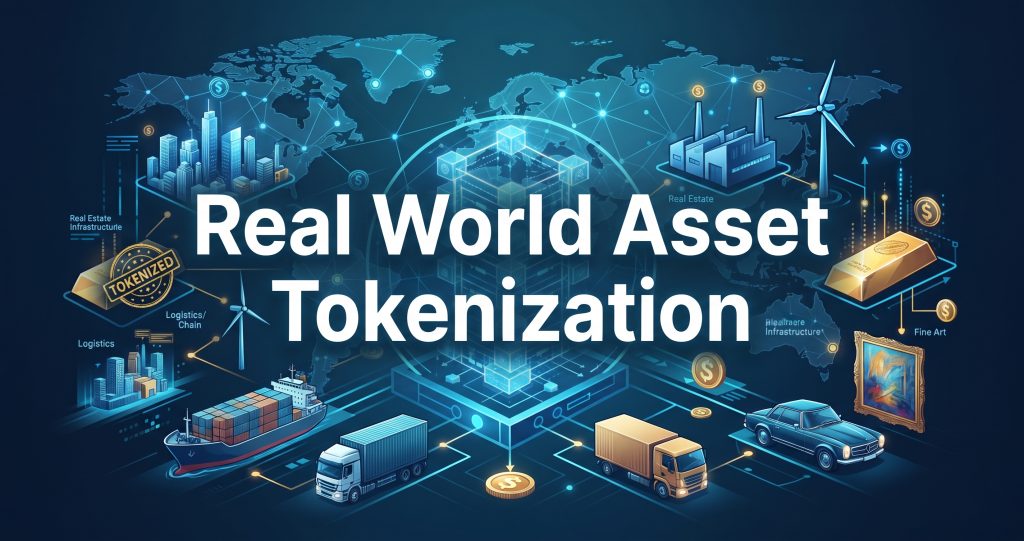
Imagine owning a fraction of a property, Treasury fund, private credit instrument, commodity, or other traditional asset through a blockchain-based platform. That is the promise behind real world asset tokenization, one of the fastest-developing areas of blockchain and financial technology in 2026. Instead of keeping ownership records entirely inside traditional financial systems, tokenization creates digital representations of real-world assets that can be held, transferred, settled, and potentially integrated with programmable financial applications.
The market is already moving beyond experimentation. RWA.xyz currently tracks approximately $38.4 billion in distributed tokenized asset value across 196 platforms, while its broader data also separates distributed assets from represented assets. This article explains how asset tokenization works, which assets can be tokenized, its benefits and risks, leading use cases, regulatory considerations, blockchain infrastructure, institutional adoption, and what the future could mean for investors and businesses.
What Is Real World Asset Tokenization?
Real world asset tokenization is the process of representing an asset, ownership interest, claim, or financial relationship connected to a physical or traditional financial asset through blockchain-based digital tokens. Depending on the structure, the token may represent direct ownership, beneficial ownership, a claim against an issuer, or another legally defined interest. The underlying asset can be anything from government debt and corporate credit to real estate, private equity, commodities, collectibles, or carbon credits.
The important point is that putting an asset’s information on a blockchain does not automatically transfer legal ownership. A successful tokenization system needs a connection between the blockchain record and the legal, custodial, or registry infrastructure that establishes what the token actually represents. The SEC’s 2026 statement on tokenized securities similarly emphasizes that tokenized securities can use different structures and can provide different rights to holders.
How Does Asset Tokenization Work?
The basic process begins with an identifiable real-world asset and a legal structure explaining how ownership or economic rights will be represented. An issuer, asset manager, custodian, special-purpose vehicle, or other authorized entity then creates digital tokens associated with that structure.
A simplified tokenization process looks like this:
- Identify the underlying asset.
- Establish ownership and legal rights.
- Select a custody or registry arrangement.
- Create the tokenized representation.
- Deploy the token on a compatible blockchain.
- Verify investor or user eligibility where required.
- Distribute tokens to approved participants.
- Manage transfers and ownership records.
- Process income, redemptions, and corporate actions.
- Maintain the connection between the token and the underlying asset.
The technology can make ownership records easier to transfer and automate, but legal enforceability remains fundamental.
Why Is Asset Tokenization Growing?
The growth of real world asset tokenization is being driven by a combination of institutional interest, blockchain infrastructure improvements, demand for yield-bearing digital assets, and the desire to modernize traditional financial markets. Banks, asset managers, fintech companies, crypto firms, and infrastructure providers are increasingly exploring blockchain as a distribution and settlement layer.
RWA.xyz’s current platform data shows 207 total tokenization platforms when distributed and represented categories are combined, with 196 classified as distributed platforms. This indicates that the ecosystem is no longer limited to a handful of experimental projects. At the same time, adoption remains uneven: a 2026 industry report based on RWA.xyz data found that more than 7,000 tokenized assets existed, while 88% of value was concentrated in only 62 assets.
What Is Driving Institutional Adoption?
Institutions are interested because blockchain may improve several parts of the financial lifecycle rather than simply creating a new form of investment.
Key motivations include:
- Faster settlement
- Programmable ownership
- Digital distribution
- Automated compliance
- Fractional investment
- Improved collateral mobility
- Transparent transaction records
- Global accessibility
- Reduced reconciliation
- Integration with digital payments
The strongest adoption is likely to occur where tokenization solves a specific operational problem.
Which Real-World Assets Can Be Tokenized?
Almost any asset with clearly defined ownership or economic rights can potentially be represented through tokenized infrastructure. However, some asset classes are much easier to tokenize than others because their ownership, valuation, custody, and legal status are already standardized.
Government securities have become one of the most mature categories. Tokenized Treasury products allow investors to access government-debt exposure through blockchain infrastructure. Other growing categories include private credit, corporate bonds, equities, funds, commodities, real estate, and alternative assets.
RWA.xyz currently tracks asset categories ranging from U.S. Treasury debt and stocks to private equity, real estate, commodities, credit, venture capital, and specialty finance.
| Asset Class | Tokenization Potential | Main Challenge |
| U.S. Treasuries | Very high | Regulation and distribution |
| Corporate bonds | High | Legal structure and liquidity |
| Private credit | High | Valuation and transparency |
| Public equities | High | Securities regulation |
| Real estate | High | Legal ownership and valuation |
| Commodities | High | Custody and verification |
| Private equity | Moderate to high | Liquidity restrictions |
| Carbon credits | High | Registry integration |
| Collectibles | Moderate | Authenticity and valuation |
| Infrastructure assets | Emerging | Complex ownership structures |
The quality of a tokenized asset depends on the relationship between the digital token and the underlying asset.
Tokenized Treasuries and Government Debt
Treasury securities have emerged as one of the most successful applications of blockchain-based asset representation. They offer a familiar underlying asset, established financial markets, dollar-denominated returns, and relatively standardized custody arrangements.
RWA.xyz’s current market overview lists U.S. Treasury debt as one of the major tokenized asset classes. The growth of Treasury funds on blockchain networks has also attracted major asset managers, financial institutions, and digital-asset companies.
Why Are Treasuries Popular?
Treasuries offer several characteristics that make them attractive for tokenization:
- High institutional familiarity
- Strong secondary markets
- Standardized securities
- Dollar denomination
- Income generation
- Potential use as collateral
- Compatibility with stablecoin ecosystems
This category can serve as a bridge between traditional fixed-income markets and digital financial infrastructure.
Tokenized Stocks and Equities
Public equities are another major area of development. Tokenized stocks can represent shares or legally connected interests in publicly traded companies, although the exact rights vary significantly between products.
The SEC’s January 2026 statement explains that tokenized securities can be issued or tokenized on behalf of an issuer or created by an unrelated third party. That distinction matters because a token that provides direct shareholder rights is fundamentally different from a synthetic product that simply tracks the price of a stock.
Tokenized equity infrastructure could eventually support continuous trading, fractional ownership, faster settlement, automated corporate actions, and blockchain-based collateral.
Real Estate Tokenization
Real estate is one of the most frequently discussed applications because property is traditionally expensive, geographically constrained, and difficult to divide into small ownership units.
Tokenization can potentially divide the economic interest in a property into digital units. Instead of one investor purchasing an entire building, multiple eligible investors could hold fractional interests through a compliant structure.
However, property tokenization is more complicated than creating a token. Land registries, local property laws, title systems, taxation, tenant rights, mortgage claims, and transfer restrictions all need to be considered.
How Tokenized Real Estate Could Work
A property could be placed into a legal entity or investment vehicle. Investors could then purchase tokens representing interests in that structure.
Potential advantages include:
- Lower investment minimums
- Digital ownership records
- Automated distributions
- Potential secondary trading
- Global investor access
- Programmable compliance
- Easier portfolio diversification
The major challenge remains secondary liquidity. Tokenization makes an asset digital, but it does not automatically create buyers.
Private Credit and Tokenized Lending
Private credit has become another important RWA category. Private credit funds and lending arrangements can be represented through blockchain tokens, potentially allowing investors to monitor positions and receive income through programmable infrastructure.
This can be particularly useful because private credit markets traditionally involve significant paperwork, bilateral relationships, and complex reporting.
Tokenization can potentially improve transparency and operational efficiency, although credit risk remains exactly that: credit risk. A blockchain token does not eliminate the possibility that a borrower fails to repay.
Why Private Credit Is Important
Tokenized credit can provide:
- Digital loan records
- Automated distributions
- Investor reporting
- Portfolio transparency
- Programmable repayment
- Potential secondary markets
Investors must still assess borrower quality, collateral, duration, default risk, and legal enforceability.
Private Equity and Venture Capital
Private equity and venture capital are also being explored for tokenization. These investments can have long holding periods and traditionally require significant administrative work.
A tokenized fund structure could potentially streamline subscriptions, ownership records, reporting, and transfer procedures.
However, private-market assets often have restrictions on who can invest and when interests can be transferred. As a result, tokenization does not necessarily mean that a private-equity position becomes freely tradable.
Commodity Tokenization
Gold and other commodities can also be represented through blockchain tokens. In a typical structure, a custodian holds physical commodities while digital tokens represent ownership or a claim associated with the stored assets.
The key requirement is reliable verification. Investors need confidence that the physical commodity exists, is properly stored, is not double-counted, and can be redeemed according to the terms.
Commodity tokenization can potentially make traditionally physical assets easier to transfer and integrate into digital portfolios.
Gold as a Tokenized Asset
Gold is especially suitable because it already has established custody and valuation infrastructure. Tokenization can add digital transferability and potentially allow gold exposure to interact with blockchain applications.
However, storage costs, redemption conditions, audit procedures, and issuer risk still matter.
Carbon Credits and Environmental Assets
Carbon credits represent another emerging use case. Blockchain can potentially provide transparent records of issuance, transfer, retirement, and ownership.
Research published in August 2026 proposed an architecture for connecting Indonesia’s regulated carbon registry with public-blockchain infrastructure while keeping the authoritative registry responsible for the status of carbon units.
This illustrates an important principle: tokenization does not necessarily replace an existing registry. Blockchain can instead operate as an additional programmable layer connected to an authoritative real-world system.
How Blockchain Adds Value
The central advantage of real world asset tokenization is that blockchain can provide a common digital layer for ownership, settlement, and financial applications. Traditional assets often move through multiple disconnected systems. A blockchain network can potentially make the transaction record shared, machine-readable, and programmable.
This can reduce some forms of reconciliation and allow financial logic to be executed through smart contracts. For example, a tokenized asset could automatically distribute income to eligible holders or enforce transfer restrictions.
Key Blockchain Features
The technology can provide:
- Immutable transaction history
- Programmable transfers
- Digital ownership records
- Smart-contract automation
- Wallet-based access
- Interoperability
- Faster settlement
- Transparent transaction activity
These benefits only matter when the legal and operational infrastructure supports them.
Distributed Assets vs Represented Assets
One of the most useful concepts in modern tokenization research is the difference between distributed and represented assets. RWA.xyz defines distributed assets as assets where blockchain functions as a distribution layer, allowing investors to subscribe to, hold, and manage assets directly through their own wallets or custodians.
Represented assets can have a different structure and may not provide the same level of direct blockchain interaction. This distinction is important because the word “tokenized” can otherwise make very different products appear identical.
Why This Classification Matters
Two products can both appear on a blockchain while offering completely different functionality.
One may allow:
- External wallet transfers
- Onchain settlement
- Smart-contract interaction
- Digital custody
Another may simply use blockchain technology internally while keeping users inside a controlled platform.
Therefore, investors should evaluate actual functionality rather than relying on terminology.
Benefits of Real World Asset Tokenization
The potential benefits extend beyond cryptocurrency investors. Financial institutions can potentially use tokenized assets for collateral management, settlement, treasury operations, investment distribution, and automated workflows.
For investors, tokenization can make certain markets more accessible and potentially reduce minimum investment sizes. For issuers, it can create new distribution channels and potentially improve operational efficiency.
A successful tokenization system can therefore benefit multiple participants simultaneously.
| Benefit | Potential Impact |
| Fractional ownership | Lower investment barriers |
| Faster settlement | Improved capital efficiency |
| Programmability | Automated financial actions |
| Digital records | Easier reconciliation |
| Global distribution | Broader investor reach |
| Transparency | Better transaction visibility |
| Composability | Integration with financial apps |
| Automation | Lower operational workload |
The actual benefits depend on product design and regulation.
Tokenization and DeFi
Tokenized assets can potentially connect traditional financial markets with decentralized finance. Once an asset exists as a blockchain-based token, it may be technically possible to use it within lending markets, automated strategies, collateral systems, or other decentralized applications.
However, legal eligibility remains a major limitation. A security cannot automatically become unrestricted simply because it exists as a smart-contract token.
The future of RWA-focused DeFi will likely involve permission systems that combine blockchain composability with regulatory requirements.
Potential DeFi Applications
Tokenized RWAs could potentially support:
- Collateralized lending
- Onchain repo markets
- Structured products
- Automated asset management
- Yield strategies
- Stablecoin reserves
- Portfolio diversification
- Institutional financing
The largest opportunities are likely to come from assets that already have strong legal and operational structures.
Tokenized Assets as Collateral
Collateral is one of the most practical applications. Financial markets depend heavily on assets that can be pledged against obligations.
Tokenized Treasuries, equities, and other securities could potentially move through digital collateral systems more efficiently than assets locked inside traditional workflows.
The ability to transfer collateral rapidly can reduce idle capital and potentially improve liquidity management. This is particularly relevant for institutions operating across multiple markets and jurisdictions.
Why Digital Collateral Matters
Traditional collateral processes can involve:
- Asset identification
- Custody verification
- Legal documentation
- Transfer instructions
- Settlement
- Reconciliation
Blockchain-based systems could automate parts of this workflow.
However, legal control over collateral must remain enforceable outside the blockchain.
The Importance of Stablecoins
Stablecoins are becoming an important payment layer for tokenized assets. If an investor wants to purchase a tokenized bond, property interest, or equity, the transaction needs a payment mechanism.
Stablecoins can potentially provide blockchain-native dollar liquidity. This creates a natural relationship between stablecoins and tokenized real-world assets.
The broader RWA market is therefore not isolated from the stablecoin economy. RWA.xyz currently reports more than $300 billion in stablecoin value alongside its tokenized-asset data.
How Stablecoins Support Tokenization
Stablecoins can potentially provide:
- Digital settlement
- 24/7 payment availability
- Cross-border transfers
- Programmable payments
- Trading liquidity
- Collateral movement
This combination could become an important foundation for onchain financial markets.
Risks of Real World Asset Tokenization
Despite its potential, real world asset tokenization introduces significant risks. The most important is that blockchain ownership and real-world legal ownership are not automatically identical.
A token can move perfectly onchain while the underlying asset is improperly custodied, encumbered, misvalued, or unavailable for redemption. This is why legal agreements, audits, custodians, registries, and verification mechanisms remain essential.
A 2026 research paper examining tokenized RWA markets also warns that tokenization and secondary-market liquidity are distinct outcomes. In other words, putting an asset onchain does not guarantee that it will become liquid.
Main Risks to Consider
- Legal uncertainty
- Custody risk
- Issuer risk
- Smart-contract vulnerabilities
- Oracle failures
- Liquidity shortages
- Valuation problems
- Regulatory changes
- Counterparty risk
- Redemption restrictions
- Blockchain outages
- Cybersecurity threats
Tokenization changes infrastructure; it does not remove investment risk.
Liquidity: The Biggest Misconception
One of the most common assumptions is that tokenization automatically makes illiquid assets liquid.
That is not necessarily true.
A tokenized property may be easier to transfer technologically, but it still needs willing buyers. A private-credit token may exist on a public blockchain but have little secondary-market activity.
Research published in 2026 specifically investigated this issue and found that onchain representation should not be confused with meaningful secondary-market liquidity.
What Creates Real Liquidity?
Real liquidity generally requires:
- Active buyers and sellers
- Market makers
- Transparent pricing
- Reliable settlement
- Legal transferability
- Sufficient investor demand
- Appropriate trading venues
Blockchain can improve the rails, but it cannot manufacture demand.
Regulation and Compliance
Regulation is one of the most important components of the tokenization ecosystem. When the underlying asset qualifies as a security, tokenization does not automatically remove securities-law obligations.
The SEC’s January 2026 statement makes clear that tokenized securities remain securities and that different tokenization structures can provide different rights.
Other assets may fall under property, commodities, banking, investment-fund, payments, environmental, or other regulatory frameworks. The applicable rules depend on the asset and jurisdiction.
What Compliance Can Include
A compliant tokenization platform may need:
- Know-your-customer procedures
- Anti-money-laundering controls
- Investor eligibility checks
- Transfer restrictions
- Sanctions screening
- Custody requirements
- Disclosure obligations
- Tax reporting
- Corporate-action management
Smart contracts can help automate some controls, but legal compliance remains broader than code.
The Role of Custody
Custody is crucial because many tokenized assets still depend on traditional financial or physical custody.
For example, a tokenized gold product may require a vault. A Treasury token may depend on a securities custodian. A real-estate token may depend on a legal entity holding property rights.
The blockchain token is therefore only one component of the ownership structure.
What Investors Should Ask About Custody
Before investing, ask:
- Who holds the underlying asset?
- Is the custodian regulated?
- What happens if the issuer fails?
- Is the asset segregated?
- Can the asset be independently verified?
- How does redemption work?
- Who controls the private keys?
- What legal claim does the token provide?
These questions can reveal risks that are invisible from a token’s market price.
Blockchain Networks Used for RWAs
Multiple blockchain networks now support tokenized assets. RWA.xyz currently tracks 39 networks in its network analytics, with Ethereum representing a major share of distributed RWA value.
Other networks compete through lower transaction costs, faster processing, institutional integrations, or specialized financial infrastructure.
The future may involve multiple interconnected networks rather than one universal blockchain.
Read More: 
What Makes a Blockchain Suitable for RWAs?
Important characteristics include:
- Security
- Reliability
- Transaction capacity
- Cost efficiency
- Developer ecosystem
- Regulatory compatibility
- Institutional support
- Wallet infrastructure
- Interoperability
For regulated assets, compliance and identity functionality can be just as important as transaction speed.
Interoperability and the Future of Tokenization
The next phase of tokenization may depend heavily on interoperability. Investors and institutions do not want assets trapped on isolated networks.
They may want a Treasury token on one network to interact with collateral systems on another, while maintaining ownership, compliance, and settlement rules.
The DTCC and other financial-market organizations have been working on interoperability issues, reflecting the growing importance of connecting digital securities infrastructure. RWA.xyz’s citations database lists DTCC’s February 2026 work on digital-asset securities interoperability among major institutional developments.
Why Interoperability Matters
Without interoperability, tokenization could create another fragmented financial ecosystem.
With interoperability, assets could potentially move between:
- Banks
- Exchanges
- Custodians
- Blockchains
- Wallets
- DeFi applications
- Payment networks
This could make blockchain more useful as financial infrastructure.
Institutional Adoption
Large financial institutions are increasingly treating tokenization as a strategic technology rather than a short-term crypto experiment.
RWA.xyz’s current platform rankings include major institutional and digital-native participants, while its research ecosystem tracks developments from BlackRock, Franklin Templeton, J.P. Morgan, State Street, Fidelity, WisdomTree, Apollo, and other major financial organizations.
This institutional participation matters because financial markets require trusted infrastructure. Banks and asset managers can provide custody, compliance, distribution, and liquidity that blockchain startups may struggle to build independently.
How Tokenization Could Change Asset Management
Asset management could become increasingly digital as funds, securities, and alternative investments move onto blockchain networks.
An asset manager could potentially issue a fund token, automate subscriptions, calculate ownership, distribute income, and provide investor reporting through connected infrastructure.
This does not necessarily eliminate asset managers. Instead, it may allow them to automate administrative functions and focus more heavily on portfolio management and investor relationships.
Potential Changes for Investors
Investors could eventually experience:
- Faster subscriptions
- Digital fund ownership
- Smaller investment minimums
- Automated distributions
- More transparent records
- Broader asset access
- Easier portfolio management
The exact benefits will depend on regulation and product design.
Tokenization and the Future of Banking
Banks are also examining tokenization because it can potentially improve settlement, collateral management, and liquidity operations.
Recent developments show that central banks are considering blockchain infrastructure as part of future financial systems. In August 2026, ECB board member Isabel Schnabel argued that central banks should embrace blockchain and discussed the potential for programmable collateral and tokenized central-bank money.
This suggests that tokenization may eventually involve not just private crypto networks, but the core infrastructure of regulated financial markets.
Tokenization Beyond Finance
Although financial assets dominate the market, tokenization can also apply to physical and environmental assets.
Potential applications include:
- Carbon credits
- Renewable-energy certificates
- Agricultural commodities
- Intellectual property
- Infrastructure projects
- Collectibles
- Luxury goods
- Equipment
- Supply-chain assets
The biggest challenge is proving the connection between the digital token and the physical asset.
The Oracle Problem
Blockchains are excellent at recording digital events but cannot independently determine whether a physical building exists or whether a shipment actually contains a specific commodity.
External data providers, auditors, registries, IoT devices, custodians, and legal systems may therefore remain essential.
This is commonly called the oracle problem: the blockchain needs trustworthy information from the real world.
How to Evaluate a Tokenized RWA
Investors should not judge a tokenized asset solely by its blockchain network or advertised yield.
The first question should be: What exactly does the token represent?
Then evaluate the issuer, underlying asset, custody structure, legal rights, valuation methodology, redemption process, liquidity, fees, blockchain security, and regulatory status.
A useful checklist is:
- Underlying asset
- Legal structure
- Issuer
- Custodian
- Valuation method
- Token rights
- Investor eligibility
- Transfer restrictions
- Redemption terms
- Fees
- Liquidity
- Smart-contract security
- Regulatory jurisdiction
This approach helps separate genuine financial innovation from marketing language.
What Is the Future of Real World Asset Tokenization?
The future of real world asset tokenization is likely to involve a gradual shift from simply creating digital representations toward building complete onchain financial workflows.
The market already shows evidence of this transition. RWA.xyz’s current platform data reports more than $38 billion in distributed tokenized asset value, while its research framework emphasizes that tokenization exists across a spectrum rather than as a simple onchain/offchain binary.
The next stage could involve tokenized assets being used as collateral, traded through regulated venues, settled with digital money, incorporated into automated investment strategies, and connected across multiple blockchain networks.
Will Tokenization Replace Traditional Finance?
Tokenization is unlikely to eliminate traditional finance entirely.
Banks, custodians, exchanges, asset managers, lawyers, auditors, regulators, registries, and payment providers still perform essential functions. Instead, blockchain may become another layer within the existing financial ecosystem.
The most realistic future is therefore hybrid. Traditional institutions may continue controlling legal ownership and compliance while blockchain networks handle distribution, settlement, programmability, and digital interaction.
Why Hybrid Finance May Win
A hybrid model can combine:
- Traditional legal protections
- Regulated custody
- Established market expertise
- Blockchain settlement
- Digital ownership
- Programmable finance
- Global connectivity
This approach may prove more practical than attempting to rebuild the entire financial system from scratch.
Frequently Asked Questions:
What is real world asset tokenization?
It is the process of representing ownership or economic rights connected to real-world assets through blockchain-based digital tokens.
What assets can be tokenized?
Treasuries, bonds, stocks, real estate, private credit, commodities, funds, carbon credits, and other assets can potentially be tokenized.
Does tokenization mean I legally own the physical asset?
Not necessarily. The token’s legal rights depend on the issuer, custody arrangement, contract, and applicable law.
Is asset tokenization the same as cryptocurrency?
No. Tokenization can represent traditional financial or physical assets, while cryptocurrencies are generally native digital assets.
Does tokenization make illiquid assets liquid?
Not automatically. Blockchain can make transfers easier, but meaningful liquidity still requires buyers, sellers, market infrastructure, and legal transferability.
Are tokenized assets regulated?
Many are subject to existing financial regulations, particularly when the underlying asset is a security. The exact rules depend on the asset and jurisdiction.
What is the biggest benefit of tokenization?
Potential benefits include faster settlement, fractional ownership, programmable transactions, improved transparency, and more efficient financial operations.
What is the biggest risk?
A major risk is assuming that the blockchain token guarantees the same rights and value as the underlying asset. Legal, custody, liquidity, and issuer risks remain important.
Which blockchain is best for RWAs?
There is no universal answer. Ethereum is currently a major RWA network, but institutions and issuers are using multiple networks depending on cost, security, compliance, and interoperability requirements.
Will tokenization become mainstream?
The market is already expanding, but adoption remains uneven. The long-term outcome will depend on regulation, liquidity, interoperability, institutional adoption, and whether tokenization produces measurable efficiency gains.
Conclusion
Real world asset tokenization is evolving from a blockchain experiment into a broader financial-infrastructure movement. Government debt, equities, private credit, real estate, commodities, funds, and environmental assets are increasingly being represented through digital tokens, while financial institutions are exploring blockchain for settlement, custody, collateral, and distribution. Current RWA.xyz data shows tens of billions of dollars in distributed tokenized assets, demonstrating that the market has moved beyond its earliest stage.
Still, tokenization is not a magic solution. A digital token does not automatically create legal ownership, liquidity, or investor protection. The strongest projects will be those that connect blockchain technology with reliable custody, clear legal rights, transparent valuation, regulatory compliance, and genuine market demand. If these foundations continue developing, tokenized real-world assets could become an important bridge between traditional finance and the programmable economy.