Getting a job offer feels great. But the process isn’t finished until you send back a joining letter confirming you accept the role and will show up on the agreed date. It sounds like a small formality, but HR teams treat it as an official record it triggers your ID card, your salary account, your desk allotment, and your onboarding paperwork.
This guide breaks down exactly what a joining letter is, the format it should follow, and gives you ready-to-use samples for Word, PDF, freshers, experienced professionals, and even pharmaceutical companies. No jargon, no legal-sounding filler just what you need to write one confidently.
What is a joining letter, really?
A joining letter is a short, formal note from a new employee to an employer, confirming acceptance of the job offer and stating the exact date of joining. Think of it as a written “yes” that follows your verbal or email acceptance.
It usually goes to HR or your reporting manager shortly after you receive the offer letter, and it often comes with supporting documents such as ID proof, certificates, and photographs attached.
A joining letter matters for two reasons:
- For the employer: It confirms your appointment is finalized so they can prepare your onboarding, payroll setup, and workstation.
- For you: It becomes proof of your official start date, which can matter later for HR records, background checks, or provident fund and insurance paperwork.
Without this letter, many companies consider the hiring process incomplete even if you’ve already had a verbal conversation about joining.
The five pieces you need
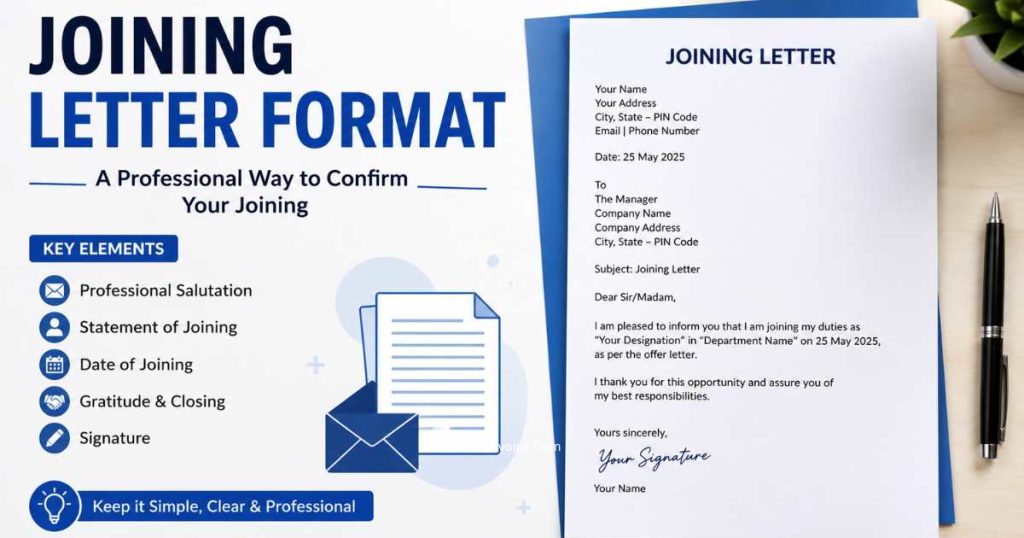
Every joining letter, no matter the industry or seniority level, follows the same basic structure. You don’t need to memorize legal phrases just cover these five parts:
- Sender’s details and date your full name, address, email, phone number, and the date you’re writing the letter.
- Recipient’s details the company name, HR manager’s name (or “The HR Manager” if unknown), and the office address.
- Subject line a one-line summary like “Joining confirmation for [Job Title]” so it’s instantly recognizable in an inbox full of applications.
- Body the core of the letter, where you reference the offer letter date, confirm your joining date, and list the documents you’re attaching.
- Closing a short thank-you note, followed by “Yours sincerely” or “Yours faithfully” and your signature.
| Section | What to Include | Typical Length |
| Sender’s details | Name, address, email, phone, date | 3–4 lines |
| Recipient’s details | Company name, HR/manager name, address | 2–3 lines |
| Subject line | Role name + “joining confirmation” | 1 line |
| Body | Offer reference, joining date, documents list | 3–5 sentences |
| Closing | Thanks, signature, designation | 2 lines |
Sticking to this five-part layout keeps your letter professional without sounding stiff or overly formal.
Joining letter format in Word
If you want an editable version you can update for every job change, a Word (.docx) template works best because you can adjust fonts, insert your signature, and reuse it later.
A standard Word-based joining letter format looks like this:
[Your Name]
[Your Address]
[Email] | [Phone Number]
[Date]
To,
The HR Manager
[Company Name]
[Company Address]
Subject: Joining Confirmation for [Job Title]
Dear Sir/Madam,
I am writing to confirm my acceptance of the offer letter dated [offer date] for the position of [Job Title]. I agree to the terms and conditions mentioned in it and will join on [joining date].
I have attached the following documents as requested:
– [Document 1]
– [Document 2]
– [Document 3]
Please let me know if you require any further information before my joining date.
Yours sincerely,
[Your Name]
Tips for formatting in Word:
- Use a simple, readable font like Calibri or Arial at 11–12 pt.
- Keep left alignment; avoid centering the body text.
- Save the file as “JoiningLetter_YourName.docx” so it’s easy for HR to identify.
- Convert to PDF before sending if the company hasn’t asked for an editable file.
Joining letter format PDF
Many companies specifically request a PDF version because it locks the formatting and can’t be accidentally edited. A PDF also looks more polished when opened on different devices.
To create a PDF joining letter:
- Write the letter in Word or Google Docs using the format above.
- Proofread carefully check the joining date, company name spelling, and your contact details.
- Export or “Save As” PDF (in Word: File → Save As → select PDF; in Google Docs: File → Download → PDF Document).
- Rename the file clearly, such as “JoiningLetter_ArjunNair.pdf”.
- Attach it to your email along with any other requested documents like mark sheets or ID proof.
A PDF joining letter format is especially useful when you’re sending scanned signatures or when the company’s HR portal only accepts PDF uploads.
Joining letter format for employee
When an employer issues a joining letter to a new employee (rather than the employee writing to HR), the format shifts slightly. It becomes more of a confirmation notice from the company, welcoming the employee and outlining key onboarding details.
A joining letter format for an employee typically includes:
- Employee’s full name and designation
- Department and reporting manager
- Confirmed joining date and reporting time
- Work location (office/hybrid/remote)
- Documents the employee must bring or submit
- A point of contact for queries before day one
Sample excerpt:
Dear [Employee Name],
We are pleased to confirm your appointment as [Job Title] in the [Department] team, reporting to [Manager Name]. Please join us on [Date] at [Time] at our [Location] office. Kindly bring the original documents listed below for verification.
This version is HR-issued rather than employee-written, so the tone is welcoming and instructional rather than a request for acceptance.
Joining letter format for job
If you’re a job seeker preparing to send your own joining letter after accepting an offer, here’s the most commonly used format across industries:
- Start with your contact details and the date.
- Address the letter to the HR manager or hiring authority.
- Use a subject line naming the role you’re joining.
- In the opening line, thank them for the offer and reference its date.
- Clearly state your joining date and confirm you accept the terms.
- List any documents you’re attaching.
- Close with appreciation and your signature.
This format for a job joining letter works whether you’re a fresher, mid-level professional, or returning after a career break only the tone and document list change slightly based on your experience level.
Simple joining letter format
Sometimes you just need a short, no-frills version especially when HR only expects a quick email confirmation rather than a formal letter.
Simple joining letter format example:
Subject: Joining Confirmation for [Job Title]
Dear [HR Manager’s Name],
This is to confirm that I accept the offer letter dated [date] for the position of [Job Title]. I will join on [joining date] as agreed. I have attached the required documents for your reference.
Regards, [Your Name] [Phone Number]
This version works well for email submissions where a full-page letter feels unnecessary. It still covers the essentials acceptance, joining date, and documents in under five sentences.
Related Post: Timewarp TaskUs Explained: Complete Guide & Uses 2026 SEO
Joining letter for pharmaceutical company
Joining letters for pharmaceutical companies generally follow the same core structure, but they often reference role-specific details such as compliance training, product knowledge, or regulatory certifications, since the industry is closely regulated.
A pharmaceutical joining letter may additionally mention:
- The specific division (Sales, R&D, Quality Assurance, Regulatory Affairs, etc.)
- Any mandatory compliance or GMP (Good Manufacturing Practice) training dates
- Pharmacy council registration or degree certificates to be submitted
- Territory or plant location assignment, especially for medical representative roles
Sample excerpt:
Dear Sir/Madam,
I am writing to confirm my acceptance of the offer letter dated [date] for the position of Medical Representative at [Pharmaceutical Company Name]. I will join on [date] at the [City/Territory] office and have attached my degree certificate, pharmacy council registration, and other requested documents.
I look forward to contributing to the team and completing the required product training at the earliest.
Yours sincerely, [Your Name]
Because pharmaceutical roles often involve licensing and compliance checks, it helps to explicitly mention any certifications you’re submitting alongside the standard documents.
Frequently Asked Questions
What is the difference between a joining letter and an offer letter?
An offer letter is issued by the employer proposing the job terms, while a joining letter is the employee’s written acceptance confirming the date they will start work.
How soon should I send my joining letter after accepting an offer?
Ideally within 24 to 48 hours of accepting the offer, so HR can proceed with onboarding and documentation without delays.
Can a joining letter be sent by email instead of a printed letter?
Yes, most companies accept a joining letter as an email or PDF attachment, and only a few formal industries require a physically signed copy.
What documents should I attach with my joining letter?
Common attachments include educational certificates, ID proof, passport-size photographs, previous employment relieving letters, and salary slips if applicable.
Is a joining letter legally binding?
While it’s not a contract itself, a joining letter is a documented confirmation of acceptance and can serve as evidence of the agreed employment start date if disputes arise later.
Conclusion
Writing a joining letter doesn’t need to feel intimidating. At its core, it’s just a clear, polite confirmation that you accept a job offer and will start on a specific date whether you send it as a formal Word document, a locked PDF, or a short email. What matters most is accuracy: the right joining date, correctly spelled company name, and a complete list of attached documents.
Whether you’re a fresher writing your first-ever joining letter, an experienced professional switching companies, or joining a pharmaceutical firm with extra compliance steps, the same five-part structure works every time. Keep the tone respectful but natural, proofread before sending, and keep a copy for your own records. Once it’s sent, your job move is officially confirmed the next step is simply showing up ready to make a strong first impression.