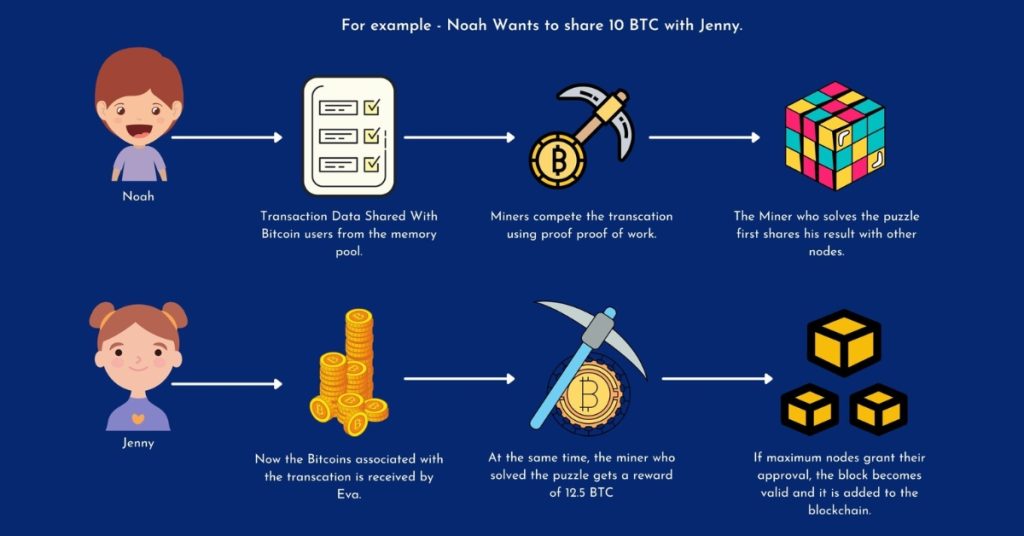
Bitcoin is a decentralized digital currency that allows people to transfer value online without relying on a bank or central authority. Understanding bitcoin transaction explained simply starts with knowing how a transaction moves Bitcoin from one user to another through the blockchain. A wallet uses private keys to authorize the payment, while the Bitcoin network verifies whether the transaction follows its rules. Miners then confirm valid transactions by including them in blocks secured through proof-of-work. The blockchain permanently records this transaction history, creating a transparent and distributed ledger. Bitcoin can be bought through exchanges, stored in wallets, transferred between users, or used where merchants accept it, although volatility, security, and regulatory risks remain important considerations.
What Is Bitcoin?
Bitcoin is a decentralized digital currency that allows value to be transferred electronically without requiring a traditional financial institution to approve every transaction. Unlike conventional currencies such as U.S. dollars, Bitcoin is not issued by a central bank. Instead, its rules are implemented through open-source software and maintained by a distributed network of computers.
The idea was introduced by the person or group using the name Satoshi Nakamoto. In 2008, Nakamoto published Bitcoin: A Peer-to-Peer Electronic Cash System, describing a payment system designed to allow online payments to move directly between participants without relying on a trusted financial intermediary.
The easiest way to understand bitcoin transaction explained simply is to think of Bitcoin as a shared accounting system. Instead of a bank maintaining one private database showing who owns what, Bitcoin uses a public blockchain. Network participants independently check transactions and agree on the valid history of transactions.
For example, imagine Alice owns 0.01 BTC and wants to send 0.003 BTC to Bob. Alice’s wallet creates a transaction using funds that she previously received. Her wallet signs the transaction using her private key. The transaction is then broadcast to the Bitcoin network.
Nodes check whether the transaction follows Bitcoin’s rules. If valid, it can enter the pool of unconfirmed transactions. A miner may eventually include it in a block. Once that block becomes part of the blockchain, the transaction receives confirmation.
This process explains how Bitcoin works without requiring a bank to maintain the central record.
Bitcoin can be used in several ways:
- Sending money directly to another person.
- Paying participating merchants, retailers, or stores.
- Moving value between cryptocurrency exchanges and personal wallets.
- Holding Bitcoin as an investment.
- Using small units of Bitcoin for payments.
- Transferring funds internationally without relying on traditional payment rails.
However, Bitcoin is not risk-free. Its market price can be highly volatile, transactions generally cannot simply be reversed by a central authority, and losing access to private keys can mean losing access to funds.
How Bitcoin Started
Bitcoin’s history begins in 2008. Satoshi Nakamoto introduced the concept through the Bitcoin whitepaper, which proposed a peer-to-peer electronic cash system capable of recording transactions without a trusted third party.
The Bitcoin.org domain was registered in August 2008, while Nakamoto announced the Bitcoin concept to a cryptography mailing list in October 2008. The first Bitcoin software followed in January 2009.
The launch was important because Bitcoin combined several existing ideas, including digital signatures, cryptographic hashing, peer-to-peer networking, and proof-of-work, into one payment system.
The goal was not simply to create another digital token. The larger objective was to create a system in which participants could determine transaction history without depending on a central institution.
That distinction is important. Digital money existed before Bitcoin. Banks and payment companies had long maintained electronic records of money. Bitcoin’s innovation was creating a system where ownership and transaction history could be coordinated through a decentralized network.
The original design also addressed the double-spending problem. Digital information can normally be copied, so a digital payment system needs a way to prevent someone from spending the same funds twice. Bitcoin uses its blockchain, transaction validation rules, and proof-of-work consensus mechanism to establish which valid transaction history the network recognizes.
The Bitcoin network launched with the genesis block in January 2009. From there, additional blocks were added as miners competed to secure the network and process transactions.
First Block
The first Bitcoin block is known as the genesis block or Block 0. It was mined on January 3, 2009, and serves as the starting point of Bitcoin’s blockchain.
A blockchain can be imagined as a growing sequence of linked containers. Each block contains transactions and information that connects it cryptographically to the preceding block.
The genesis block is different because it has no normal previous Bitcoin block. It is the foundation from which subsequent blocks are connected.
The next block, commonly called Block 1, was mined on January 9, 2009. From that point onward, Bitcoin mining became the process through which new blocks could be added to the chain.
Each block contains a block header. The header includes important information such as:
- Block version
- Previous block hash
- Merkle root
- Timestamp
- Difficulty-related target information
- Nonce
Bitcoin’s developer documentation describes the block header as an 80-byte structure used in the proof-of-work process. The previous block hash connects the current block to the earlier block, while the Merkle root summarizes the transactions contained in the block.
This structure is one reason changing old blockchain data is difficult. If someone modified a transaction in an old block, the transaction hashes and Merkle root would change. That would alter the block’s hash and break the connection to subsequent blocks.
The system therefore creates a chain in which historical changes require substantial computational work.
Rewards
Bitcoin mining is the process through which specialized computers compete to produce valid blocks. Miners collect transaction fees from transactions included in their blocks and, when applicable, receive newly issued bitcoin through the block subsidy.
When Bitcoin launched in 2009, the mining reward was 50 BTC per block.
Bitcoin’s issuance schedule is designed so that the block subsidy is periodically reduced. This event is called a halving because the subsidy is approximately cut in half.
The reward dropped to 25 BTC in 2012, then 12.5 BTC in 2016, 6.25 BTC in 2020, and 3.125 BTC in April 2024. Based on Bitcoin’s programmed schedule, the next halving is expected around 2028, reducing the block subsidy to 1.5625 BTC.
The halving mechanism is significant because it controls the rate at which new bitcoins enter circulation. Unlike traditional currencies, where a central monetary authority can change issuance policies, Bitcoin’s issuance schedule is embedded in its protocol.
Mining itself has also changed dramatically. Early Bitcoin mining could be performed using ordinary computer processors. Competition later moved toward graphics processing units and then specialized ASICs, or application-specific integrated circuits.
Modern Bitcoin mining requires substantial computing power and electricity. Individual miners may participate through a mining pool, where many miners combine their computational resources and share rewards according to the work they contribute.
Mining software such as CGMiner and BFGMiner has historically been used to communicate with mining hardware, although modern mining operations often use specialized systems and infrastructure.
Denominations
Bitcoin does not have to be purchased or transferred as one whole bitcoin.
One bitcoin can be divided into 100 million units, with the smallest standard unit called a satoshi.
The relationship is:
| Bitcoin amount | Equivalent |
| 1 BTC | 100,000,000 satoshis |
| 0.1 BTC | 10,000,000 satoshis |
| 0.01 BTC | 1,000,000 satoshis |
| 0.001 BTC | 100,000 satoshis |
| 0.000001 BTC | 100 satoshis |
| 0.00000001 BTC | 1 satoshi |
Important
Understanding a Bitcoin transaction becomes much easier when you separate four concepts: the wallet, private key, transaction, and blockchain.
A cryptocurrency wallet is software or hardware that helps users manage the cryptographic keys associated with their Bitcoin. The wallet does not contain physical coins. Bitcoin ownership is represented through transaction outputs recorded on the blockchain.
Read More : What Is Blockchain? The Technology Changing Digital Trust
A private key is secret cryptographic information that gives the holder the ability to authorize spending of Bitcoin controlled by the corresponding key. It should never be shared.
A wallet address is a destination that can be provided to someone who wants to send Bitcoin. Modern addresses can appear as long strings of letters and numbers and may be presented through QR codes for easier mobile payments.
The basic transaction process can be simplified into these steps:
- The sender enters or scans the recipient’s Bitcoin address.
- The sender specifies how much Bitcoin to transfer.
- The wallet selects appropriate unspent transaction outputs.
- The wallet creates a transaction containing inputs and outputs.
- The wallet uses the sender’s private key to authorize the transaction.
- The transaction is broadcast to the Bitcoin network.
- Network nodes check whether the transaction follows Bitcoin’s rules.
- A miner may include the transaction in a block.
- Once the block is accepted into the blockchain, the transaction receives confirmation.
Bitcoin transactions do not simply move coins from one wallet file to another. Technically, Bitcoin uses transaction inputs and outputs. An input references an earlier transaction output, while a new output specifies where value can be spent next.
The Bitcoin developer documentation describes raw transactions as serialized data that can be hashed to create a transaction identifier, or TXID.
This is why a bitcoin transaction explained simply is best understood as a cryptographically authorized update to the network’s shared record.
Buying Bitcoin is a separate process from using the Bitcoin network. A person can purchase Bitcoin through a cryptocurrency exchange using methods that may include a bank account, debit card, or wire transfer, depending on the platform and jurisdiction.
After purchasing Bitcoin, users can keep it on an exchange or withdraw it to a personal wallet. Keeping funds under personal control can provide greater direct control over private keys, but it also means the user becomes responsible for protecting those keys.
Bitcoin can also be used as a payment method where merchants accept it. However, acceptance varies by country, business, and payment provider.
Investors should also understand that Bitcoin’s market price is affected by factors including investor sentiment, regulatory developments, macroeconomic conditions, market liquidity, adoption, and demand. Exchange-traded funds (ETFs) and other regulated investment products can also influence market access and investor behavior.
Bitcoin’s Blockchain Technology
Bitcoin’s blockchain is the technical foundation that allows the network to maintain a shared transaction history without a single central database administrator.
The blockchain is maintained across a distributed network of computers. Participants called nodes independently receive and validate transactions according to Bitcoin’s consensus rules.
This creates a distributed ledger. Instead of one company controlling the authoritative database, multiple computers maintain and verify copies of the network’s history.
The concept becomes clearer with a simple example.
Suppose Alice sends 0.005 BTC to Bob. Alice’s transaction is broadcast to the network. Nodes independently examine whether Alice has the necessary unspent funds and whether the transaction’s authorization is valid.
A valid transaction can be relayed through the peer-to-peer network. Miners collect transactions and construct candidate blocks. They then compete to produce a block satisfying Bitcoin’s proof-of-work requirement.
The block contains a header and transactions. Its header references the previous block through its hash and contains a Merkle root derived from the transactions. Bitcoin’s technical documentation confirms that changing a transaction changes the relevant cryptographic data leading into the block header.
The blockchain therefore provides a chronological structure for Bitcoin transactions.
It is also important to distinguish encryption from hashing. People sometimes use these terms interchangeably, but they are not the same.
Encryption is normally designed so information can be transformed into an unreadable form and later decrypted with the appropriate key. Bitcoin relies heavily on cryptographic hashing and digital signatures instead.
Hashing converts data into a fixed-length output. Bitcoin uses the SHA-256 hashing algorithm extensively. A SHA-256 result is a 256-bit value commonly represented as a 64-character hexadecimal number.
Bitcoin’s proof-of-work system requires miners to find a block-header hash that meets a network-defined target. This creates a computational cost for producing blocks.
Blockchain
A Bitcoin block contains transactions and a header that links it to the blockchain.
The key components of a block header include the previous block hash, Merkle root, timestamp, target information, nonce, and version. Bitcoin’s developer documentation specifies these components and explains how the header participates in proof-of-work.
The previous block hash is particularly important. It connects one block to the block before it. If an attacker changes the contents of an earlier block, its hash changes. The next block would then point to the old hash, exposing the inconsistency.
The Merkle root is another important component. Rather than putting every transaction directly into the header, Bitcoin hashes transaction identifiers into a Merkle tree and produces one root hash representing the transactions in the block.
The timestamp records block-time information, while the difficulty target establishes how difficult it is for miners to produce a qualifying hash.
The nonce is a value miners change repeatedly while searching for a valid block hash. When miners exhaust possible nonce values, their software can alter other parts of the candidate block, such as extra nonce information in the coinbase transaction, producing a new Merkle root and another range of possible hashes.
A transaction counter can also appear in Bitcoin protocol messages to indicate how many transactions are associated with a block message. It should not be confused with the block header itself.
Read More : How to Buy Bitcoin Safely in 2026 Without Losing Money
The network also uses protocol-level fields such as a software or protocol magic number to help identify Bitcoin network messages. This is a networking concept rather than a field that determines whether a Bitcoin transaction is valid.
This distinction matters because Bitcoin has many technical components, but each performs a specific job.
Encryption
Cryptography is central to Bitcoin, but describing Bitcoin simply as an “encrypted currency” is inaccurate.
Bitcoin uses several cryptographic techniques for different purposes.
Hashing helps create transaction identifiers, block identifiers, Merkle roots, and proof-of-work calculations. Bitcoin commonly applies SHA-256 hashing, including double SHA-256 in several protocol operations.
Digital signatures provide evidence that the person attempting to spend funds has the required private key. Bitcoin’s transaction scripts use signature-checking operations to validate authorized spending.
A simplified transaction can therefore be understood like this:
Private key → digital signature → transaction → network verification → block → blockchain
The private key is secret. The corresponding public information allows the network to verify the signature without revealing the private key.
This is one reason wallet security is so important. If someone obtains a user’s private keys or recovery credentials, that person may be able to authorize transactions. Bitcoin’s decentralized design does not provide a central administrator who can automatically reverse an unauthorized transfer.
Mining adds another layer of security. Miners use ASIC hardware to repeatedly calculate hashes while searching for a result below the network’s target threshold. The Bitcoin developer documentation describes this process as repeatedly changing the nonce and hashing the block header until a valid result is found.
Modern mining is extremely competitive. Large mining farms can operate tens or hundreds of thousands of ASICs, while a new high-performance ASIC can cost around $10,000 or more depending on the model and market conditions.
For that reason, mining Bitcoin from an ordinary home computer is generally not Economically Competitive with professional mining operations.
Bitcoin’s blockchain security is therefore not based on one technology alone. It combines cryptographic signatures, hashing, proof-of-work, economic incentives, network rules, and independent verification by nodes.
FAQS
What is a Bitcoin transaction in simple terms?
A Bitcoin transaction is a digitally authorized instruction that transfers control of Bitcoin from existing transaction outputs to new outputs. The transaction is broadcast to the network, checked by nodes, and can eventually be included in a blockchain block.
How does Bitcoin work without a bank?
Bitcoin uses a peer-to-peer network and a distributed ledger instead of a central bank maintaining the transaction record. Nodes verify transactions, while miners compete to add valid blocks through proof-of-work.
What is a Bitcoin wallet?
A Bitcoin wallet is software, hardware, or another system that manages the cryptographic keys used to control Bitcoin. The Bitcoin itself remains represented by transaction data on the blockchain.
What is a private key?
A private key is secret cryptographic information that authorizes spending. Anyone with control of the necessary private key can potentially authorize transactions for the associated funds, so private keys must be protected carefully.
What is a satoshi?
A satoshi is the smallest standard unit of Bitcoin. One bitcoin equals 100 million satoshis.
What is Bitcoin mining?
Bitcoin mining is the process of using computational power to compete for the right to add a new block to the blockchain. Successful miners can receive the block subsidy and transaction fees associated with their blocks.
What is an ASIC?
An ASIC, or application-specific integrated circuit, is specialized hardware designed for a particular computational task. Bitcoin miners use ASICs because they are far more suitable for Bitcoin’s SHA-256 proof-of-work calculations than ordinary general-purpose computers.
What is a blockchain?
A blockchain is a chronological chain of blocks containing Bitcoin transaction information. Each block is cryptographically connected to the previous block, creating a shared history that network participants can independently verify.
Is Bitcoin the same as cryptocurrency?
Bitcoin is a cryptocurrency, but cryptocurrency is the broader category. Bitcoin was the first widely recognized decentralized cryptocurrency, while thousands of other digital assets have since been created with different designs and purposes.
Can Bitcoin transactions be reversed?
Generally, Bitcoin transactions are not reversible in the same way a credit-card payment can be charged back. Once a transaction is confirmed and accepted by the network, reversing it normally requires the recipient to voluntarily send the funds back.
Is Bitcoin used only for investment?
No. Bitcoin can be used for payments, transfers, savings, and other financial purposes. In practice, its use varies by country, merchant acceptance, regulations, fees, and user preferences.
Why is Bitcoin sometimes called digital gold?
Bitcoin is sometimes called digital gold because some investors view it as a scarce digital asset that can potentially serve as a store of value. The comparison is not a guarantee that Bitcoin will behave like gold. Bitcoin remains considerably more volatile and carries different technological, market, security, and regulatory risks.
Why does Bitcoin have a halving?
The halving reduces the number of new bitcoins created through mining approximately every four years. It is part of Bitcoin’s programmed monetary issuance system and helps limit the rate at which new supply enters circulation.
Final words
Bitcoin is a decentralized digital currency that enables people to transfer value directly over the internet without relying on a central bank. Created by Satoshi Nakamoto, Bitcoin uses blockchain technology, cryptographic techniques, private keys, and a peer-to-peer network to verify transactions. Each transaction is checked by network participants before being included in a block. Miners use specialized ASIC hardware and proof-of-work to secure the network and add new blocks to the blockchain.
Bitcoin can be bought through cryptocurrency exchanges, stored in wallets, transferred to other users, or used where merchants accept it. It is divisible into 100 million satoshis per bitcoin. Its main risks include volatility, security threats, regulatory uncertainty, and irreversible transactions.