
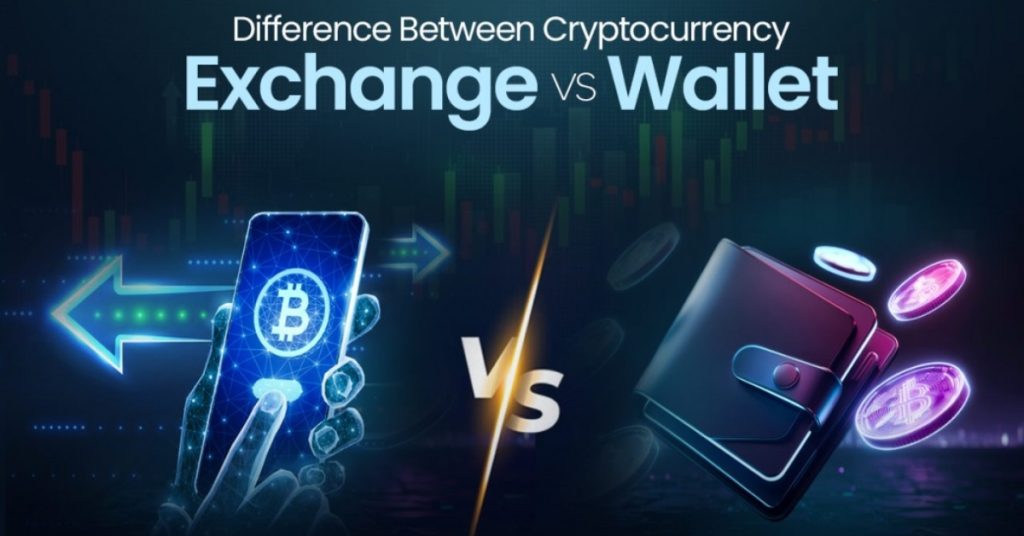
Choosing between a bitcoin wallet vs exchange is an important decision for anyone buying, trading, or holding Bitcoin. While both help users manage digital assets, they serve very different purposes. A cryptocurrency exchange is mainly built for purchasing Bitcoin, trading assets, accessing liquidity, and converting fiat currency. A cryptocurrency wallet focuses on custody, blockchain access, and control over private keys. The biggest differences involve security, ownership, convenience, privacy, recovery, transaction speed, and asset support. Exchanges can be easier for beginners and active traders, while non-custodial and hardware wallets may suit users who prioritize self-custody and long-term control. Understanding these differences helps you choose the right storage and management approach for your Bitcoin.
What is a cryptocurrency wallet?
A cryptocurrency wallet is a software or hardware tool that allows users to interact with blockchain networks and manage digital assets. Despite the word “wallet,” it does not literally store Bitcoin or other cryptocurrencies inside the device. Your assets remain recorded on the blockchain.
The wallet stores or manages the cryptographic information needed to authorize transactions. The most important piece of that information is the private key. Whoever controls the private key generally has control over the associated blockchain assets.
Cryptocurrency wallets are broadly divided into custodial and non-custodial wallets.
A custodial wallet is controlled by a third party. The service provider manages the private keys on behalf of the user. Many exchange accounts effectively work this way because the exchange controls the underlying keys while customers receive account balances.
A non-custodial wallet gives the user direct control over the private keys. This approach is commonly described as self-custody. MetaMask, Trust Wallet, and hardware wallets such as Ledger and Tangem are examples of tools commonly associated with user-controlled custody.
Wallets can also be divided into hot and cold categories. Hot wallets remain connected to the internet and are convenient for regular transactions. Cold wallets keep key information offline and are generally preferred for long-term storage.
Hardware wallets are a popular form of cold storage. They are physical devices designed to keep sensitive key information isolated from ordinary internet-connected activity. Paper wallets are another historical form of cold storage, although they introduce their own risks, including physical damage, loss, and human error.
A wallet becomes particularly useful when someone wants direct control over digital assets, access to DeFi (Decentralized Finance), interaction with dApps (decentralized applications), NFT (Non-Fungible Tokens) marketplaces, or participation in blockchain ecosystems without relying entirely on a centralized platform.
Security tips and risk management
Self-custody gives you control, but it also creates personal responsibility. There is usually no customer-service department capable of reversing a transaction simply because you made a mistake.
The most important security practices include:
- Never share your private keys.
- Never give your seed phrase to another person or website.
- Store your seed phrase offline in a secure location.
- Use a hardware wallet for significant long-term holdings.
- Download wallet software only from legitimate sources.
- Verify blockchain addresses before sending funds.
- Avoid entering recovery phrases into websites or online forms.
- Keep wallet software and devices updated.
- Use a separate wallet for experimental dApps when appropriate.
- Be extremely careful with suspicious links and token approvals.
A seed phrase is a sequence of words used to restore access to many non-custodial wallets. It should be treated like the master backup to the wallet. If someone obtains it, they may be able to access the associated assets.
This is why self-custody is not simply about owning a wallet. It is about understanding custody, backups, authorization, and personal security.
What is a cryptocurrency exchange?
A cryptocurrency exchange is a platform where users can buy, sell, trade, and sometimes store digital assets. Exchanges are often the starting point for beginners because they combine several functions into one account.
Major platforms such as Binance, Coinbase, and Crypto.com provide access to cryptocurrency markets, depending on the user’s country and the services available there.
Most large platforms are centralized exchanges (CEX). A CEX operates through a company that manages the platform, matching trades, maintaining user accounts, providing market infrastructure, and generally handling custody for assets held on the platform.
For example, someone may deposit fiat currency through a fiat on-ramp, purchase Bitcoin, and leave the Bitcoin in the exchange account. This can be convenient because the user does not immediately need to manage a seed phrase or hardware device.
Exchanges also provide features that can be difficult to reproduce with a basic wallet. These can include trading pairs, order books, liquidity, recurring purchases, market charts, conversions, staking services, and withdrawal systems.
However, exchange custody means users generally do not have the same direct control over private keys that they have with a non-custodial wallet.
Some exchanges also provide additional security tools, including two-factor authentication (2FA), withdrawal whitelists, anti-phishing protection, fraud detection, device management, and other account-security controls.
Exchanges can therefore be highly convenient, but convenience should not be confused with complete ownership control.
Main differences between a wallet and an exchange
The difference between a cryptocurrency wallet and an exchange becomes clearer when you compare what each tool is designed to accomplish.
| Feature | Cryptocurrency Wallet | Cryptocurrency Exchange |
| Primary purpose | Asset custody and blockchain interaction | Buying, selling, and trading |
| Private-key control | Often controlled by the user | Usually controlled by the platform |
| Custody | Often self-custody | Usually third-party custody |
| Trading | Usually limited or connected to DEXs | Core function |
| KYC | Often not required for basic wallet creation | Commonly required |
| Recovery | Seed phrase in non-custodial wallets | Account recovery process |
| Security responsibility | Mostly the user | Shared between user and platform |
| DeFi access | Strong | Usually indirect |
| dApp access | Strong | Limited or platform-dependent |
| Fiat on-ramps | Usually limited | Common |
| Long-term storage | Cold wallets are suitable | Exchange custody is convenient but introduces platform risk |
Control and ownership of keys
The biggest distinction in the crypto wallet vs exchange debate is control over private keys.
With a non-custodial wallet, the user generally controls the private keys. This means the user has greater direct control over the assets.
With an exchange account, the exchange generally controls the private keys associated with assets held in its custody. Your account displays your balance, but the underlying custody arrangement is different from holding coins in a personally controlled wallet.
This distinction is often summarized by the idea that control of the keys determines control of the assets.
Self-custody therefore offers greater control and ownership, but it also creates greater responsibility. Losing your seed phrase, exposing your private key, approving a malicious transaction, or sending funds to the wrong address can have serious consequences.
A centralized exchange can provide account recovery mechanisms, but users must trust the platform’s security and operational systems.
Security and risk
Security works differently in both systems.
An exchange concentrates risk at the platform level. A major exchange may maintain extensive security infrastructure, fraud detection, account monitoring, withdrawal controls, and other protections. Some platforms may also offer insurance coverage for certain circumstances, although users should never assume that every loss is automatically covered.
A personal wallet shifts much of the security burden to the individual.
If your hardware wallet is stolen but your recovery information remains secure, the thief may not automatically gain access to your funds. However, if your seed phrase is exposed, the situation can be much more serious.
The risks can therefore be summarized as follows:
- Exchange risk includes platform failure, account compromise, withdrawal restrictions, regulatory intervention, and third-party custody.
- Wallet risk includes lost seed phrases, phishing, malware, malicious dApps, incorrect addresses, and user mistakes.
- Market volatility affects both regardless of where assets are held.
- Blockchain transactions are generally difficult or impossible to reverse after confirmation.
The safest approach is not simply choosing one technology. It is understanding the risks attached to each custody model.
Convenience and functionality
Exchanges generally win when convenience is the priority.
A new user can create an account, complete required identity verification, connect a payment method, deposit fiat currency, and purchase Bitcoin through a single platform.
Exchanges are also designed for active traders. They commonly provide trading pairs, charts, market orders, limit orders, liquidity information, and other tools.
Wallets are different. They are particularly useful for people who want direct blockchain access.
For example, a non-custodial wallet can connect to dApps and DeFi applications. Tools such as WalletConnect allow compatible wallets to interact with supported applications. Users can also interact with decentralized exchanges such as Uniswap.
Some users may use DEX aggregators such as 1inch to compare routes across decentralized liquidity sources. Portfolio tools such as Zapper can help users monitor certain DeFi positions and blockchain activity.
This makes wallets more flexible for advanced blockchain use, while exchanges are often easier for conventional trading.
KYC requirements and privacy
KYC requirements, meaning identity verification procedures, are common on centralized exchanges.
Depending on jurisdiction and platform rules, users may be asked to provide information such as their legal name, identification documents, residential information, and other verification details.
This process can feel less private, but it supports regulatory compliance and allows exchanges to operate within financial rules in many markets.
A basic non-custodial wallet generally works differently. Creating a wallet does not necessarily require opening an account with a company or completing traditional KYC.
However, blockchain transactions are not automatically anonymous. Public blockchain networks can record transaction activity permanently, and blockchain addresses can sometimes be connected to real-world identities through exchange records, blockchain analysis, or other information.
Therefore, the difference is better understood as custodial identity requirements versus direct blockchain interaction, rather than simply “private versus public.”
Account recovery and backups
Account recovery is another major difference.
An exchange account usually relies on conventional recovery methods. If you forget a password, you may be able to reset it through email, authentication methods, identity verification, or customer support.
Read More : Bitcoin Private Key vs Public Key: What’s the Difference
A non-custodial wallet generally relies on its recovery phrase.
If the wallet is lost or the device stops working, the seed phrase can often restore access using a compatible wallet application.
But this creates an important trade-off.
With an exchange:
Less responsibility for key management, but more dependence on the platform.
With self-custody:
More control, but more personal responsibility.
A user who chooses self-custody should create a secure backup strategy before transferring meaningful amounts of cryptocurrency.
Transaction speed and accessibility
Transaction speed depends on what action you are performing.
An internal exchange transfer between users on the same platform may happen quickly because it does not necessarily require an immediate blockchain transaction.
Blockchain withdrawals, however, require network processing and may depend on congestion, fees, confirmation requirements, and the specific blockchain.
Wallet transactions interact directly with blockchain networks. Their speed can therefore vary according to network conditions.
For Bitcoin, transaction confirmation is influenced by network activity and fee selection. Other blockchains may have very different confirmation times.
Exchanges can therefore feel faster for internal trading and account transfers, while wallets provide direct access to on-chain transactions.
Accessibility also matters. Exchange platforms typically provide web and mobile interfaces designed for mainstream users. Wallets may require users to understand addresses, networks, transaction fees, confirmations, and blockchain-specific details.
Asset support and integrations
Asset support can vary significantly between exchanges and wallets.
A large exchange may support hundreds of digital assets, but its available assets depend on its listing policies, jurisdiction, liquidity, and regulatory requirements.
Wallets can sometimes interact with a much wider range of blockchain assets because the wallet acts as an interface rather than a traditional exchange listing platform.
MetaMask, for example, is widely associated with Ethereum and compatible networks and is commonly used to access dApps and DeFi services.
Trust Wallet supports numerous blockchain ecosystems and is designed as a multi-asset wallet.
Coinbase Wallet is separate from the standard Coinbase exchange account and provides self-custody functionality for supported assets and blockchain applications.
Ledger and Tangem represent hardware-based approaches to cryptocurrency custody, designed to keep sensitive signing information more isolated from internet-connected environments.
The best option depends on what you actually need. Someone holding only Bitcoin may have very different requirements from someone using multiple networks, NFTs, DeFi protocols, and dApps.
When to use a wallet vs an exchange?
The right choice depends on your objective rather than on a universal rule.
An exchange may make more sense when you:
- Are new to cryptocurrency.
- Frequently buy or sell assets.
- Need fiat currency on-ramps.
- Want access to trading pairs and market liquidity.
- Prefer account-based recovery.
- Need a simple interface for regular purchases.
A wallet may make more sense when you:
- Want self-custody.
- Plan to HODL Bitcoin for the long term.
- Want direct control over private keys.
- Use DeFi applications.
- Interact with dApps.
- Buy or manage NFTs.
- Need direct blockchain transactions.
- Want cold storage for long-term holdings.
A hybrid strategy can be practical for many users.
For example, someone might keep a limited amount on an exchange for active trading while holding long-term digital assets in a non-custodial or hardware wallet.
This separates trading funds from long-term holdings and reduces the amount of money exposed to a single custody method.
HODLing is a cryptocurrency term derived from the phrase “Hold On for Dear Life.” It generally describes holding an asset for an extended period rather than frequently trading it. Long-term holders may place greater importance on custody and security than on immediate exchange functionality.
Common misconceptions
Several misconceptions make the wallet-versus-exchange decision more confusing than it needs to be.
“A wallet stores my Bitcoin physically”
A cryptocurrency wallet does not physically contain Bitcoin. The blockchain records ownership and transaction history. The wallet manages the information required to interact with those records.
“Self-custody is automatically safer”
Self-custody removes certain third-party risks, but it introduces personal security risks. A careless user can lose funds through phishing, malware, a compromised seed phrase, or an incorrect transaction.
“An exchange means I do not own cryptocurrency”
Exchange custody is different from self-custody, but an exchange account can still represent a user’s economic interest in digital assets. The important distinction is who controls the underlying keys and what rights the platform’s terms provide.
“Cold wallets cannot be hacked”
Cold wallets reduce exposure to online attacks, but no security system eliminates every risk. Physical theft, fake devices, malicious setup procedures, compromised recovery phrases, and social engineering can still create problems.
“DEXs are just wallets”
A decentralized exchange, or DEX, is a trading protocol rather than simply a wallet. Uniswap is a prominent example. A wallet provides the interface for controlling assets, while the DEX facilitates decentralized trading through blockchain-based smart contracts.
“More coins always mean better asset support”
Asset support is useful only when those assets are relevant to your goals. Adding unsupported or questionable tokens can also increase complexity and risk.
All done!
The simplest way to remember the difference is this:
Exchange = convenience and trading.
Wallet = control and blockchain access.
Hardware wallet = stronger long-term custody for users willing to manage their own security.
If your priority is Frequent Trading, an exchange may be the most convenient option. If your priority is long-term ownership and control, self-custody may be more appropriate.
The amount you hold, your technical knowledge, your risk tolerance, and your ability to manage backups should all influence the final decision.
FAQS
Is it better to keep Bitcoin in a wallet or exchange?
It depends on your goals. Exchanges are convenient for buying and trading, while wallets provide greater control through self-custody. Long-term holders may prefer a secure wallet, particularly cold or hardware storage, while active traders may keep a working balance on an exchange.
Is Bitcoin safer in a wallet than an exchange?
Not automatically. A properly secured wallet can reduce certain third-party custody risks, but the user becomes responsible for private keys and recovery information. A major exchange may have advanced security systems, but users remain exposed to platform and account risks.
What is the main difference between a crypto wallet and an exchange?
The primary difference is purpose and custody. An exchange is primarily designed for trading and buying or selling digital assets, while a wallet is designed to control blockchain assets and interact with blockchain networks.
Can I buy Bitcoin without an exchange?
Yes, depending on the available services in your location. Some wallet applications provide integrated purchasing options through third-party providers. However, these services can still involve payment processors, identity checks, fees, and other restrictions.
Should I move Bitcoin from an exchange to a wallet?
If you want direct self-custody and are comfortable managing private keys and backups, moving long-term holdings to a personal wallet may be appropriate. Before transferring funds, make sure you understand the wallet and have securely backed up its recovery information.
What is the safest type of crypto wallet?
For long-term storage, properly configured hardware wallets are commonly considered a strong option because they can keep private-key operations more isolated from internet-connected devices. However, security also depends heavily on how the device, seed phrase, and transaction process are managed.
What happens if I lose my hardware wallet?
If your recovery phrase has been properly backed up, losing the physical hardware device does not necessarily mean losing access to the assets. A compatible replacement wallet can generally restore access using the recovery information.
Read More : How to Store Bitcoin Securely: Safest Methods Explained
Is MetaMask an exchange?
MetaMask is primarily a cryptocurrency wallet and blockchain interface. It can connect users with decentralized applications and decentralized trading services, but it should not be confused with a traditional centralized exchange.
What are CEX and DEX?
CEX means centralized exchange. It is operated by a company that manages the platform and commonly provides custodial services. DEX means decentralized exchange, where trading is generally facilitated by blockchain-based smart contracts rather than a traditional centralized intermediary.
Can a crypto wallet be used for DeFi?
Yes. Many non-custodial wallets can connect to DeFi protocols and dApps. WalletConnect and similar technologies can help compatible wallets interact with supported applications.
What is a seed phrase?
A seed phrase is a sequence of words used to recover a non-custodial cryptocurrency wallet. It is extremely sensitive information and should never be shared with another person or entered into an unfamiliar website.
Should I keep all my Bitcoin on an exchange?
Keeping all holdings in one place creates concentration risk. Some users separate funds between an exchange for trading and a self-custody wallet for long-term holdings. The appropriate arrangement depends on individual risk tolerance and security knowledge.
Final words
A cryptocurrency wallet and an exchange serve different purposes in managing digital assets. Exchanges such as Binance and Coinbase are designed for buying, selling, trading, and converting cryptocurrencies, offering convenience, liquidity, fiat on-ramps, and account recovery. Wallets focus on asset custody, blockchain access, and control over private keys. Non-custodial wallets provide self-custody, while hardware and cold wallets can offer stronger protection for long-term holdings. The main differences involve security, privacy, transaction speed, asset support, recovery, and functionality.
Neither option is universally safer or better. Active traders may prefer exchanges, while long-term holders and DeFi users may prefer wallets. A hybrid strategy can combine both.

