
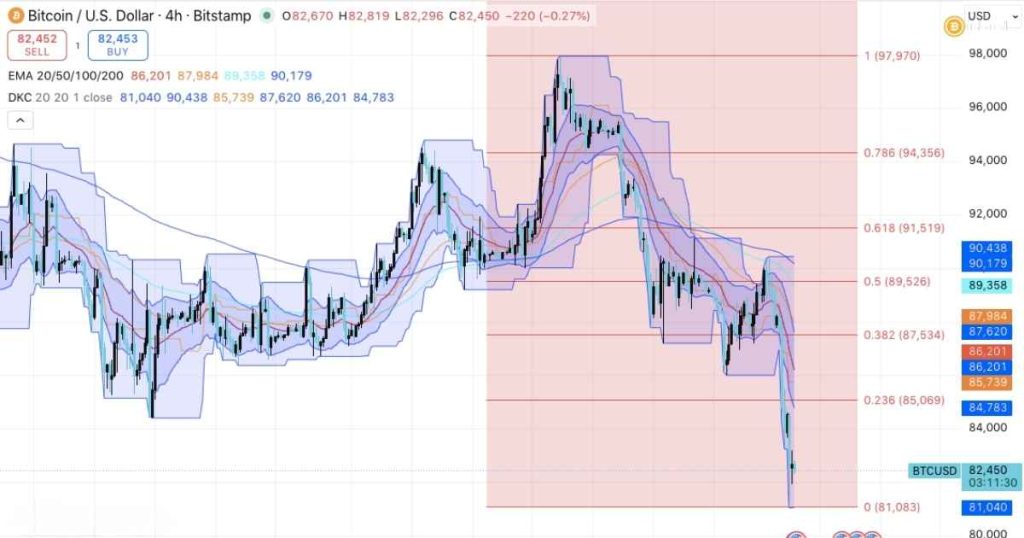
Bitcoin continues to dominate discussions in the world of cryptocurrency investment, digital assets, and blockchain technology. With each passing year, analysts, investors, and financial institutions are making increasingly bold predictions about its future value. From short-term projections to long-term forecasts, the question remains: how high can Bitcoin really go?
Following the most recent Bitcoin halving event, market experts are re-evaluating historical trends, institutional adoption, and macroeconomic factors to estimate Bitcoin’s future price. In this detailed guide, we explore major predictions, historical patterns, and key drivers that could influence Bitcoin price prediction for 2025, 2030, and 2040.
The Nakamoto Portfolio Monte Carlo Strategy Price Prediction
The Nakamoto Portfolio Theory is a financial framework that helps investors understand how Bitcoin behaves as an emerging asset class within a diversified portfolio. Unlike traditional assets, Bitcoin shows unique volatility and growth characteristics, making it both high-risk and high-reward.
Using Monte Carlo simulation models, analysts can estimate potential price movements by analyzing historical data and probability distributions. These simulations provide insight into Bitcoin return projections, risk assessment, and long-term investment strategies, though they cannot guarantee exact outcomes due to market unpredictability.
Hal Finney’s Thought Experiment — $22M per BTC
Early Bitcoin pioneer Hal Finney proposed one of the most famous long-term Bitcoin predictions. Back in 2009, he suggested that Bitcoin could reach extremely high valuations if it became a global financial system.
His reasoning was based on the total estimated global wealth, which he placed between $100 trillion and $300 trillion. If Bitcoin captured a significant portion of that value and distributed it across its limited supply of 21 million coins, each Bitcoin could theoretically reach around $22 million per BTC.
At the time, this seemed unrealistic. However, as Bitcoin adoption, institutional investment, and decentralized finance (DeFi) continue to grow, Finney’s vision is increasingly discussed as a long-term possibility.
Peter Brandt: $120K – $200K per BTC by 2025
Veteran trader Peter Brandt has predicted that Bitcoin could reach between $120,000 and $200,000 by 2025. His analysis is based on historical chart patterns, market cycles, and technical analysis indicators.
Brandt’s predictions highlight Bitcoin’s tendency to follow exponential growth cycles after each halving event. While short-term volatility remains high, long-term trends suggest strong upward momentum driven by market demand and limited supply dynamics.
Fidelity Predicts: $1B per Bitcoin by 2038–2040
Investment giant Fidelity Investments has taken a long-term view of Bitcoin’s potential. According to their macro analysis, Bitcoin could eventually reach $1 billion per coin between 2038 and 2040.
This prediction is based on increasing institutional adoption, global financial integration, and store-of-value narrative. As Bitcoin becomes more widely accepted as “digital gold,” its valuation could rise significantly in the global economy.
Chamath Palihapitiya: $500K to $1M Bitcoin Forecast
Venture capitalist Chamath Palihapitiya has made bold predictions about Bitcoin’s future, suggesting it could reach $500,000 in the near term and potentially $1 million by 2040.
His outlook is driven by the belief that Bitcoin will act as a hedge against inflation and economic instability. As governments print more money, investors may turn to decentralized assets and cryptocurrency investments as a safer alternative.
Max Keiser Predicts $200K Bitcoin
Bitcoin advocate Max Keiser has consistently predicted that Bitcoin will reach $200,000 per coin. His analysis focuses on global economic instability and the weakening of fiat currencies.
Keiser believes that Bitcoin’s fixed supply and decentralized nature make it a strong alternative to traditional financial systems. This aligns with the growing interest in Bitcoin as a hedge against inflation and currency devaluation.
Bernstein Analysts Predict Bitcoin Surge to $200K
Analysts from Bernstein have projected that Bitcoin could reach $200,000 by 2025, largely due to the rise of spot Bitcoin ETFs and institutional investments.
Since the approval of Bitcoin ETFs, billions of dollars have flowed into the market. Analysts expect ETFs to represent a growing share of Bitcoin supply, increasing demand and pushing prices higher.
This highlights the importance of institutional adoption, ETF inflows, and large-scale investor participation in shaping Bitcoin’s future price.
What Will Determine Bitcoin’s Future Price?
Several key factors will influence Bitcoin’s future value:
- Institutional adoption and ETF growth
- Global economic conditions and inflation rates
- Regulation and government policies
- Technological advancements in blockchain
- Market sentiment and investor behavior
These elements collectively shape Bitcoin market trends and long-term price predictions.
Bitcoin Pricing History and Growth Trends
Bitcoin has experienced exponential growth since its creation. From being worth a few cents to reaching tens of thousands of dollars, it has become one of the most valuable digital assets.
This growth is driven by scarcity, decentralization, and increasing global adoption. Despite volatility, Bitcoin continues to attract investors looking for long-term gains.
Impact of Bitcoin ETFs on Future Price
The approval of Bitcoin ETFs has been a major turning point. ETFs make it easier for traditional investors to gain exposure to Bitcoin without directly owning it.
This has increased liquidity and demand, contributing to Bitcoin price growth and institutional investment expansion. As more financial institutions adopt ETFs, Bitcoin’s market value could rise significantly.
Key Points
- Bitcoin Price Prediction: Analysts at Bernstein estimate that Bitcoin could reach $200,000 by 2025, increasing their earlier projection of $150,000. This reflects growing confidence in cryptocurrency market growth and long-term Bitcoin valuation.
- ETF Impact: Strong capital inflows into spot Bitcoin ETFs have played a major role in shaping this bullish outlook. These funds are making Bitcoin investment more accessible to both retail and institutional investors.
- Institutional Adoption: Major financial platforms, including large brokerages and private banks, are expected to approve and integrate Bitcoin ETF investment products, accelerating institutional crypto adoption.
- Retail vs. Institutional Investment: Currently, nearly 80% of ETF investments are coming from retail participants, while institutional investors are still gradually entering the market. This shift highlights the early stage of institutional involvement in digital assets.
- Long-term Projections: Analysts predict that Bitcoin ETFs could manage around $190 billion in assets by 2025 and potentially grow to $3 trillion by 2033, demonstrating the rapid expansion of crypto asset management and ETF-driven demand.
Bitcoin Historical Halving Events
First Halving — November 2012
- Pre-Halving Price: Approximately $11
- Post-Halving Price: Bitcoin experienced steady growth and reached around $1,100 by November 2013
The first halving introduced many investors to the concept of Bitcoin scarcity and supply reduction, showing how limited supply can drive price increases.
Second Halving — July 2016
- Pre-Halving Price: Around $650
- Post-Halving Price: Bitcoin climbed gradually and eventually reached nearly $20,000 in December 2017
This period marked the beginning of mainstream attention toward cryptocurrency trading and Bitcoin bull markets, fueled by increasing global interest.
Third Halving — May 2020
- Pre-Halving Price: About $8,000
- Post-Halving Price: Bitcoin surged to nearly $64,000 in April 2021
The third halving highlighted the importance of institutional investment and macroeconomic factors, as large companies and funds began entering the market.
Forth Halving — April 2024
- Pre-Halving Price: Approximately $61,000
- Current Bitcoin Price: Around $67,292 (July 2024 data)
- Post-Halving Price Difference: +10.52%
The latest halving reflects early signs of growth, with analysts closely monitoring post-halving Bitcoin trends and market momentum for further price action.
Post-Halving Bitcoin Price Prediction
Historical data suggests that Bitcoin often experiences strong growth after halving events. However, future price movements depend on multiple influencing factors beyond simple supply reduction.
- Adoption Rate: Increased use of Bitcoin as a store of value and digital currency can significantly boost demand and price.
- Regulatory Environment: Government policies and regulations across major economies can shape cryptocurrency market stability and investor confidence.
- Macro-Economic Conditions: Inflation rates, interest rates, and global financial trends play a major role in Bitcoin price fluctuations.
- Technological Developments: Improvements in blockchain scalability, security, and efficiency can enhance Bitcoin network utility and adoption.
Overall, while halving events create bullish conditions, Bitcoin price prediction remains complex and multi-factor driven.
Analyzing the Experts Bitcoin Price Prediction
The Nakamoto Portfolio Monte Carlo Strategy Price Prediction
Using historical data and probability models, analysts apply Monte Carlo simulations to estimate possible future price ranges. This method highlights the uncertainty of predicting Bitcoin’s exact value.
Quick Results:
- Average expected price in 1 year: $144,000
- 95% of simulations range between $30,000 and $448,000
- Worst-case scenario: Around $6,500
- Best-case scenario: Up to $901,000
These results demonstrate that Bitcoin price volatility and risk analysis make precise predictions extremely difficult. Instead of focusing on exact numbers, investors should consider probability ranges.
Despite uncertainty, about 77% of simulations show positive returns, reinforcing Bitcoin’s potential as a high-growth digital investment asset.
Fidelity Predicts: $1B per 1 BTC by 2038 — 2040
According to Fidelity Investments, Bitcoin could reach $1 billion per coin between 2038 and 2040. This prediction is supported by long-term models based on network growth.
Macro strategist Jurrien Timmer uses Metcalfe’s Law, which states that the value of a network increases as more users join it. As Bitcoin adoption expands globally, its network effect strengthens, leading to higher valuation.
This model suggests that Bitcoin could reach approximately $1 million by 2030, driven by increased adoption, network expansion, and digital asset demand. Over time, continued growth could push valuations even higher, positioning Bitcoin as a major component of the global financial system.
Understanding Bitcoin’s Value Through Metcalfe’s Law
Metcalfe’s Law states that the value of a network increases in proportion to the square of its number of users. In simple terms, as more participants join a network, its overall usefulness and value grow exponentially rather than linearly.
When applied to Bitcoin, this concept becomes extremely powerful. According to Jurrien Timmer from Fidelity Investments, Bitcoin’s expanding user base could push its value toward $1 million per BTC by 2030. This is driven by a network effect in cryptocurrency adoption, where each new user increases the system’s utility and demand.
Timmer describes this as a “supermajority feedback loop”, meaning once Bitcoin reaches a critical level of global adoption, its growth could accelerate rapidly. This reinforces Bitcoin’s role as both a digital store of value and decentralized financial network.
Fidelity has also reported that nearly 90% of its large institutional clients have shown interest in cryptocurrency investments and Bitcoin exposure. To support this demand, the firm launched Fidelity Digital Assets, focusing on secure Bitcoin custody solutions and institutional-grade crypto services.
In addition, Fidelity published a detailed report titled “Valuing Bitcoin — Modeling the Price of Bitcoin as a Monetary Asset Through Market Forces”, which further validates Bitcoin’s role in global financial markets and digital asset valuation models.
Fidelity’s Strategic Investments in Cryptocurrency
Fidelity has gone beyond research and actively invested in the crypto space. In July 2022, the firm acquired a 7.4% stake in Marathon Digital Holdings, investing approximately $20 million. This move highlights its long-term commitment to Bitcoin mining infrastructure and blockchain ecosystem growth.
The company has also been actively involved in Bitcoin ETF development, especially after the approval of spot Bitcoin ETFs by the U.S. Securities and Exchange Commission in January 2024. Fidelity’s own ETF, the Wise Origin Bitcoin Trust, has become one of the leading products in the market.
Data shows that major ETF providers like BlackRock and Fidelity are leading institutional Bitcoin adoption, with billions of dollars flowing into their funds. This surge reflects growing trust in regulated cryptocurrency investment vehicles.
Bitcoin’s large and active user base further strengthens its position as the top digital asset. As institutions onboard more clients, the network effect and market demand for Bitcoin continue to rise, reinforcing its long-term value.
Peter Brandt: $120k — $200k per 1 BTC by September 2025
Veteran trader Peter Brandt has updated his Bitcoin outlook after observing recent market behavior. He noted that Bitcoin has broken above a long-term trading channel, signaling a strong bullish trend.
Initially, Brandt projected a peak of $120,000, but due to Bitcoin’s strong price momentum and technical breakout patterns, he has revised his forecast to $200,000 per BTC.
This revision reflects growing confidence in Bitcoin technical analysis trends, breakout signals, and long-term bullish cycles. According to Brandt, Bitcoin’s price structure continues to follow historical patterns seen after previous halving events.
Chamath Palihapitiya Predicts $500k by October 2025, $1M per 1 BTC by 2040 — 42
Investor Chamath Palihapitiya views Bitcoin as more than just a digital currency. He believes it could evolve into a global reserve asset and alternative financial system.
Bitcoin’s key strengths include:
- Decentralization and censorship resistance
- Limited supply of 21 million coins
- Borderless and global accessibility
- Strong security through blockchain technology
Chamath has emphasized Bitcoin’s role as a hedge against inflation and economic uncertainty, especially during times of declining trust in traditional financial systems.
Bitcoin’s Role as a Store of Value
He argues that Bitcoin is one of the strongest store-of-value assets, particularly in unstable economic environments. As inflation rises and fiat currencies lose purchasing power, Bitcoin becomes an attractive alternative.
Scarcity Driving Value
Bitcoin’s fixed supply ensures long-term scarcity, which is a key driver of price appreciation. As demand increases and supply remains limited, prices are expected to rise significantly over time.
Interestingly, new gold discoveries, such as Uganda’s massive reserves, may dilute gold’s scarcity. In contrast, Bitcoin’s deflationary monetary policy ensures its scarcity remains intact.
Institutional Adoption Boosting Bitcoin’s Legitimacy
Major companies like Tesla, MicroStrategy, and PayPal have adopted Bitcoin, increasing its credibility. This trend supports institutional crypto adoption and large-scale capital inflows.
Bitcoin’s Technological Advancements
Continuous improvements in blockchain scalability, transaction efficiency, and security enhance Bitcoin’s usability and adoption potential.
Chamath predicts Bitcoin could reach $500,000 by 2025 and $1 million by 2040, driven by global adoption and financial system transformation.
Max Keiser Predicts $200K per 1 BTC in 2024
Bitcoin advocate Max Keiser believes current global economic conditions strongly favor Bitcoin growth. Rising debt levels, inflation, and currency devaluation create demand for alternative assets.
With U.S. national debt exceeding $34 trillion, Keiser argues that fiat currency systems are under pressure, pushing investors toward Bitcoin as a hedge against inflation.
Bitcoin as a Hedge Against Economic Instability
Bitcoin’s decentralized structure makes it resistant to government control, offering protection against economic instability and monetary policy risks.
The Deflationary Advantage of Bitcoin
Unlike fiat currencies, Bitcoin has a capped supply, making it inherently deflationary. This scarcity supports long-term price appreciation and investment demand.
Network Effects and Bitcoin’s Adoption
As more users adopt Bitcoin, its value increases due to network growth and global acceptance. This reinforces its position as a leading digital financial asset.
Volatility as an Opportunity
Keiser views Bitcoin’s volatility as an advantage rather than a risk. Price fluctuations create opportunities for traders and long-term investors to benefit from market movements.
He has also suggested that Bitcoin could eventually reach $1 million per coin, especially as adoption expands across nations and institutions.
What Will Determine Bitcoin’s 2025, 2030 & 2040 Price?
Several critical factors influence Bitcoin’s long-term valuation:
Supply and Demand Dynamics
Bitcoin’s supply is controlled by its algorithm, including halving events and mining difficulty adjustments. As supply decreases and demand rises, prices tend to increase.
Market Sentiment and Investor Behavior
Investor emotions, news, and market trends significantly affect Bitcoin’s price. Positive sentiment can trigger FOMO (fear of missing out), while negative news can lead to sharp declines.
Technological Advancements and Adoption
Improvements in blockchain technology enhance Bitcoin’s functionality, boosting user adoption and market confidence.
Regulatory Developments
Government regulations play a major role in shaping the cryptocurrency market environment. Supportive policies encourage growth, while strict regulations may limit expansion.
Bitcoin’s Pricing History
Bitcoin’s journey has been marked by extreme volatility and exponential growth. From trading at just a few cents to reaching tens of thousands of dollars, it has become a major digital investment asset.
Key milestones include:
- 2013 surge to over $700
- 2017 bull run to $20,000
- 2021 peak near $64,000
These cycles demonstrate Bitcoin market volatility, boom-and-bust patterns, and long-term growth trends.
What Will Happen to Bitcoin Now That ETFs Have Been Approved?
The approval of spot Bitcoin ETFs marks a turning point in institutional crypto adoption. It allows traditional investors to access Bitcoin through regulated financial products.
Major firms like BlackRock and Fidelity are leading this shift, bringing credibility and large-scale capital into the market.
Q1 Spot Bitcoin ETF Key Takeaways
- Over $12 billion inflows in first three months
- BlackRock’s IBIT leading with massive growth
- Increased demand contributing to price rise
These developments highlight the growing importance of Bitcoin ETFs in shaping market trends and price movements.
FAQs
What is the most realistic Bitcoin price prediction for 2030?
Bitcoin price predictions for 2030 vary widely, but many analysts suggest it could reach between $500,000 to $1 million depending on institutional adoption, market demand, and global economic conditions. However, due to crypto market volatility, these estimates should be viewed as speculative rather than guaranteed outcomes.
How do Bitcoin halving events affect price?
Bitcoin halving events reduce the number of new coins entering circulation, which decreases supply. Historically, this has led to price increases due to scarcity and rising demand, making halving one of the most important factors in Bitcoin price cycles and long-term growth trends.
Can Bitcoin really reach $1 billion per coin?
Some long-term forecasts, such as those from Fidelity Investments, suggest Bitcoin could reach extremely high valuations if it becomes a dominant global asset. However, this would require mass global adoption, financial system transformation, and extreme capital inflows, making it a highly ambitious scenario.
Is Bitcoin a good long-term investment?
Bitcoin is considered a strong long-term investment by many due to its limited supply, decentralized nature, and increasing institutional adoption. However, investors should be aware of market risks, price volatility, and regulatory uncertainty before making decisions.
What factors will impact Bitcoin’s future price the most?
Key factors include institutional adoption, regulatory changes, macroeconomic conditions, technological advancements, and market sentiment. Together, these elements shape Bitcoin price movements and long-term valuation trends in the global financial market.
Final Thoughts
Bitcoin continues to gain traction as a global digital asset and alternative financial system. Increasing institutional adoption, ETF growth, and technological advancements are strengthening its position.
Despite volatility and uncertainty, the overall outlook remains positive. Many experts believe Bitcoin will continue its upward trajectory, driven by scarcity, demand, and global adoption trends.
While exact price predictions remain uncertain, Bitcoin’s long-term potential is widely recognized. What once seemed like unrealistic forecasts are now being taken seriously as Bitcoin evolves into a cornerstone of the future financial system.

