
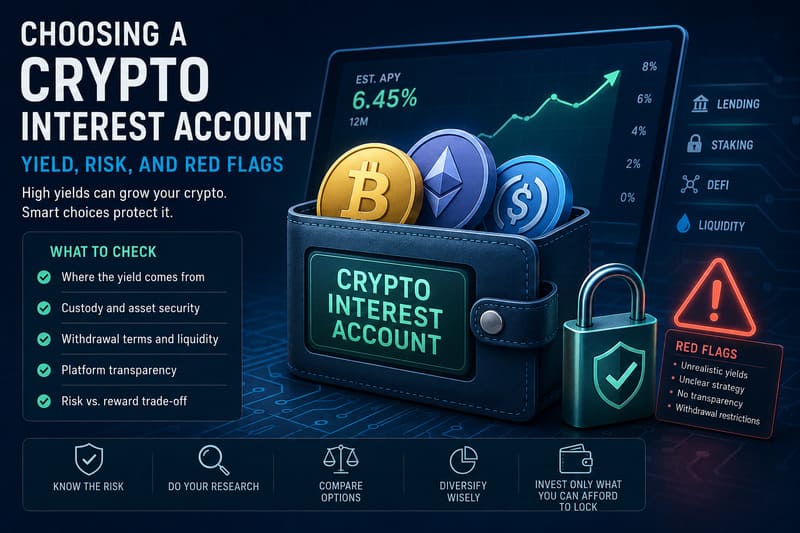
Choosing a crypto interest account means comparing how a platform generates yield, who holds your assets, how withdrawals work, and what happens if the market turns ugly. A crypto interest account is a product that pays users a return for depositing digital assets, usually through lending, staking, or DeFi strategies.
The easy version is: “deposit crypto, earn yield.” The less adorable version is: “lend or lock volatile assets inside a structure you may not fully control.” That difference matters.
Before choosing a crypto interest account, users should understand one basic rule: yield is never floating in the air. It comes from borrowers, validators, trading activity, liquidity incentives, treasury bills, or sometimes from a business model that should be read twice and trusted half as quickly.
The point is not to avoid every crypto yield product. The point is to know which risks you are being paid to take.
Choosing a crypto interest account starts with the yield source
A crypto interest account should be judged first by where the return comes from, not by the APY number on the landing page. A high yield with no clear source is not a feature; it is a smoke alarm with a nice font.
Most crypto interest products fall into four broad models:
- Centralized lending — users deposit crypto with a company, and the company lends it to institutional or retail borrowers.
- Staking-based yield — users earn network rewards by helping secure proof-of-stake blockchains, directly or through a provider.
- DeFi lending — users supply assets to smart-contract lending markets where borrowers pay interest.
- Stablecoin or cash-like rewards — users hold stablecoins or dollar-linked balances and receive rewards from a platform, treasury strategy, or promotional program.
These models are not equally risky. Centralized lending depends heavily on the company’s balance sheet, risk controls, borrower quality, and legal structure. Staking depends more on protocol rules, validator performance, slashing risk, and withdrawal mechanics. DeFi lending adds smart-contract risk, oracle risk, liquidity risk, and the charming possibility that a governance token with a cartoon animal becomes systemically important for twelve minutes.
The first question is simple: who pays the yield, and why?
If the answer is “market demand for borrowing,” ask what borrowers are doing with the funds. If the answer is “staking rewards,” ask whether assets are locked and whether the provider can be slashed. If the answer is “strategy,” ask for the exact strategy. If the answer is “rewards,” ask whether that is sustainable or just user acquisition wearing a finance costume.
Custody decides what you really own
Custody is the difference between holding an asset and holding a claim on someone else who says they hold the asset. In crypto interest accounts, this distinction is not academic; it is the small print that becomes the headline during a withdrawal freeze.
With a custodial account, the platform controls the private keys or manages the assets on your behalf. This can make the product easier to use, especially for beginners, but it also means platform failure can become user failure.
With non-custodial DeFi, users may keep wallet control while interacting with smart contracts. That removes some company-level custody risk, but it adds protocol and wallet-operation risk. A smart contract does not have a customer support department. It has code, and code is very confident even when wrong.
The practical custody checklist is:
- Does the platform clearly state whether assets are held in custody?
- Are customer assets segregated from company assets?
- Does the platform publish proof-of-reserves or third-party attestations?
- Are assets lent out, rehypothecated, staked, or deployed into DeFi?
- What happens to users if the company files for bankruptcy?
- Can withdrawals be paused at the platform’s discretion?
The last question deserves special attention. If the terms allow the platform to freeze withdrawals during “market conditions,” “liquidity events,” or “operational stress,” then instant access is not guaranteed. It may still be a reasonable product, but the user should price it like a risk product, not like a bank account with a crypto logo.
Platform risk is bigger than APY
The biggest mistake in choosing a crypto interest account is ranking platforms by yield alone. APY is visible. Risk is usually in the basement, behind three links, two PDFs, and a terms page nobody reads until the platform stops replying.
The 2022 crypto credit crisis showed why this matters. Celsius paused withdrawals in June 2022 and filed for Chapter 11 bankruptcy in July 2022. BlockFi reached a $100 million settlement with U.S. regulators over its interest accounts in February 2022 and later filed for bankruptcy after the FTX collapse. Genesis froze redemptions linked to Gemini Earn in November 2022, and the SEC later brought charges connected to the program.
These examples do not mean every yield product is doomed. They mean the phrase “earn passive income” can hide very active risk.
A serious platform should make several things clear:
- the legal entity users contract with;
- the jurisdiction and regulatory status;
- how user assets are used;
- whether lending is overcollateralized;
- whether borrowers are disclosed or institutionally vetted;
- whether the platform has audited financials;
- how it handles liquidity stress;
- whether insurance exists and what it actually covers.
Insurance is another word that needs careful handling. Some platforms advertise crime insurance, custody insurance, or smart-contract cover. That does not automatically mean users are protected against market losses, borrower defaults, platform insolvency, bad risk management, or regulatory shutdowns. “Insured” can mean “insured against a narrow event that is not the event you are worried about.” Finance enjoys this kind of comedy.
Liquidity terms matter more than the headline rate
Liquidity terms explain when and how users can get their assets back. A lower-yield account with clear withdrawal terms may be safer than a higher-yield product with vague lockups and emergency pause rights.
There are three common liquidity structures:
| Structure | How it works | Main risk | Best fit |
|---|---|---|---|
| Flexible account | Users can request withdrawals anytime | Platform may still pause withdrawals under stress | Users who value access |
| Fixed-term account | Assets are locked for a set period | No exit during market volatility | Users who accept illiquidity |
| Staking or DeFi position | Withdrawal depends on protocol or pool liquidity | Smart-contract, validator, or exit-queue risk | Users who understand on-chain mechanics |
The word “flexible” should not be confused with “guaranteed.” In centralized platforms, flexibility is only as strong as the platform’s liquidity management and legal obligations. In DeFi, liquidity may depend on market depth, collateral quality, and whether other users are trying to exit at the same time.
This is where stablecoins can be misleading. A dollar-pegged asset feels calmer than Bitcoin or Ether, but stablecoin yield still has risk. The coin can depeg, the issuer can face reserve pressure, the platform can fail, or the strategy generating the yield can break. A stable unit of account does not make the surrounding machinery stable.
A practical framework for choosing a crypto interest account
A good decision framework starts with the user’s goal. Someone parking idle stablecoins for short periods should not evaluate risk the same way as someone locking ETH for staking rewards or lending volatile assets for double-digit APY.
Use this five-step framework.
1. Define the asset and time horizon
Start with the asset. Bitcoin, Ether, stablecoins, and smaller tokens have different yield sources and different market risks. Then define the time horizon: days, months, or years.
Short-term users should prioritize liquidity and platform safety. Long-term users may accept lockups, but only when the yield source is transparent.
2. Identify the yield engine
Do not stop at the APY. Ask whether the return comes from lending, staking, DeFi liquidity, market-making, treasury assets, or promotional rewards.
If the yield source cannot be explained in one paragraph, the product may still be legitimate, but it is not simple. Complexity is not automatically bad. Hidden complexity is.
3. Read the withdrawal terms
Check lockups, cooldown periods, minimum withdrawals, withdrawal fees, emergency pause rights, and platform discretion. The most important sentence is often not in the marketing page. It is in the terms.
If the platform can suspend withdrawals broadly, treat that as a real risk, not a theoretical edge case.
4. Review platform transparency
Look for proof-of-reserves, third-party audits, public risk policies, borrower disclosures, security history, and legal clarity. A platform does not need to reveal every proprietary detail, but it should explain enough for users to understand what risk they are taking.
No transparency, no trust. Not “less trust.” No trust.
5. Size the position conservatively
Even after due diligence, crypto interest accounts should not be treated like insured bank deposits. Position sizing matters. A user can be right about the platform and still be wrong about liquidity, regulation, market stress, or timing.
A simple rule: do not deposit an amount that would force bad decisions if withdrawals were delayed.
Crypto interest account versus staking, DeFi lending, and cold storage
A crypto interest account is not the only way to put digital assets to work. It competes with staking, DeFi lending, and doing nothing at all, which in crypto is sometimes the most underappreciated risk-management strategy.
| Option | Main advantage | Main drawback | Better for |
|---|---|---|---|
| Centralized crypto interest account | Easy setup and familiar interface | Custody and platform risk | Users who want convenience |
| Direct staking | Protocol-based rewards | Lockups, validator risk, technical setup | Users holding proof-of-stake assets |
| DeFi lending | On-chain transparency | Smart-contract and liquidation risk | Advanced users |
| Cold storage | Maximum custody control | No native yield | Users prioritizing asset safety |
The right choice depends on what the user values most. Convenience usually increases platform dependence. Control usually increases personal responsibility. Yield usually increases exposure to someone else’s risk.
That is the triangle. Crypto did not invent it; it just made it programmable.
FAQ
What is a crypto interest account?
A crypto interest account is a product that pays users a return for depositing digital assets. The yield usually comes from lending, staking, DeFi activity, or platform rewards.
Are crypto interest accounts safe?
Crypto interest accounts carry risks that bank savings accounts usually do not, including platform failure, withdrawal freezes, smart-contract bugs, borrower defaults, and regulatory action. Safety depends on custody, transparency, legal structure, and how yield is generated.
Is crypto interest the same as staking?
No. Staking usually earns rewards from helping secure a proof-of-stake blockchain, while crypto interest accounts may generate yield through lending or other platform strategies. Some platforms package staking in an interest-account format, which can blur the difference.
What APY is too high for a crypto interest account?
There is no universal cutoff, but unusually high APY should trigger deeper review. Users should ask who pays the yield, what risk creates it, whether it is promotional, and whether withdrawals remain reliable under stress.

