
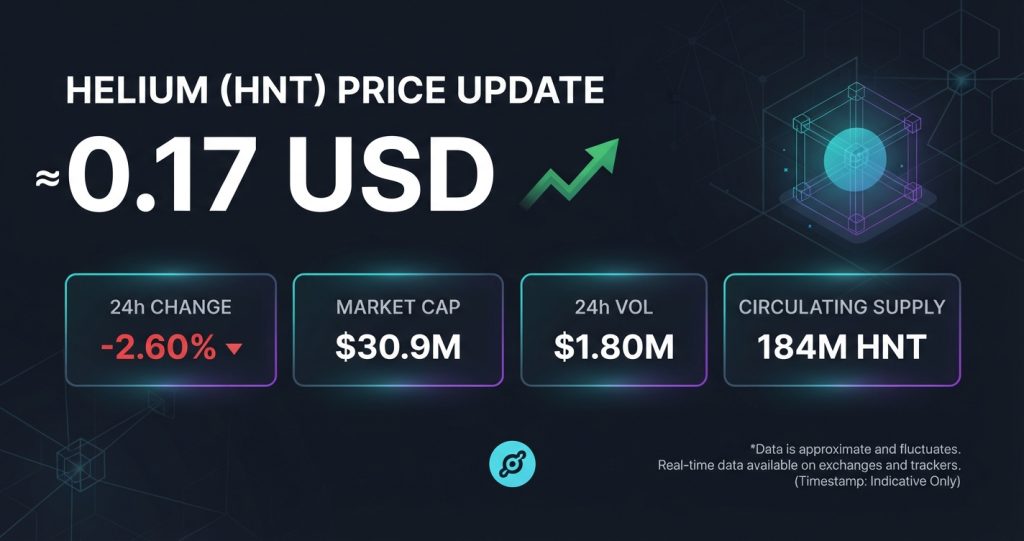
The helium crypto price is attracting attention as investors watch the Helium Network’s progress in decentralized wireless infrastructure. HNT is the native token powering the Helium ecosystem, and its value is influenced by crypto-market sentiment, network usage, supply dynamics, and demand for wireless connectivity. At the time of this writing on August 19, 2026, major market trackers place HNT around $0.18 per token, although the exact figure can vary slightly between exchanges and data providers.
This guide explains the current HNT price, market capitalization, circulating supply, historical performance, token economics, and factors that could influence future prices. It also explains why Helium’s real-world network activity matters when evaluating HNT rather than relying only on short-term price charts.
Helium Crypto Price Today
The helium crypto price is currently around $0.18, based on live market data available from major cryptocurrency platforms. CoinMarketCap recently reported HNT near $0.1814, while CoinGecko showed approximately $0.1809. Kraken also placed the token around $0.18. Small differences are normal because exchanges can have different order books, liquidity, and update times.
HNT price snapshot
| Metric | Approximate value |
| Token | Helium (HNT) |
| Current price | ~$0.18 |
| Market cap | ~$34 million |
| Circulating supply | ~182–186 million HNT |
| Maximum supply | 223 million HNT |
| 24-hour volume | ~$4–4.5 million |
| All-time high | About $55 |
| Blockchain | Solana |
Market figures change continuously, so readers should treat this table as a snapshot rather than a permanent price quote. CoinMarketCap currently lists a maximum supply of 223 million HNT and a circulating supply of about 186.3 million, while Kraken reports approximately 181.6 million circulating HNT.
What Is Helium (HNT)?
Helium is a decentralized wireless network designed to provide connectivity through community-operated infrastructure. Instead of depending entirely on traditional telecommunications infrastructure, the model allows individuals and organizations to deploy wireless equipment and participate in the network.
HNT is the native cryptocurrency of the Helium Network. Helium’s official documentation states that HNT was first emitted in July 2019 and that the network later migrated to Solana in April 2023.
The token has practical utility inside the ecosystem. Hotspot hosts and operators can receive HNT rewards, while network users rely on Data Credits for wireless data transactions. Data Credits are created by burning HNT, connecting network usage with the token’s economics.
How the Helium Network Can Affect HNT Price
The relationship between network usage and HNT is one of the most important things to understand when analyzing the token.
Helium uses a burn-and-mint economic model. Data Credits are pegged to the U.S. dollar and are used to pay for network activity. They are produced by burning HNT, meaning increased network usage can result in more HNT being removed from circulation.
This creates a potentially important connection:
- More network activity creates demand for Data Credits.
- Data Credits are produced by burning HNT.
- HNT is removed from circulation when it is burned.
- Greater network utilization can therefore influence HNT’s supply dynamics.
However, this does not mean increased usage automatically causes the market price to rise. Crypto prices also depend on investor sentiment, broader market conditions, liquidity, token emissions, competition, and speculation.
HNT Tokenomics and Supply
Token supply is a major factor when evaluating the helium crypto price.
CoinMarketCap currently reports a maximum supply of 223 million HNT, with roughly 186.3 million circulating. Helium’s documentation describes a scheduled emission structure and explains that its economics also include net emissions to support network incentives after halving events.
The important point is that investors should not look at price alone. A token priced at $0.18 can have a very different valuation from another token priced at $0.18 depending on its circulating supply and future issuance.
Burn-and-mint economics
HNT’s token model contains two competing forces:
- HNT issuance: New tokens can enter circulation through network incentives and protocol mechanisms.
- HNT burning: HNT is burned to create Data Credits used for network activity.
- Network demand: Greater real-world usage can increase the need for Data Credits.
- Market demand: Investors and users can create additional buying pressure.
The long-term balance between these forces is more important than any single daily price movement.
Helium Crypto Price History
HNT has experienced significant volatility since its launch. Its historical peak occurred during the 2021 crypto bull market, when major market data providers recorded an all-time high around the $49–$55 range, depending on the data source and methodology. CoinMarketCap records an all-time high of $55.22, while Coinbase lists $48.80.
The difference demonstrates why historical cryptocurrency prices should be checked against the methodology and exchange data being used.
HNT’s decline from its previous peak has also been substantial. At roughly $0.18, the token is far below its 2021 high. This does not automatically mean it is undervalued or guaranteed to recover. It simply shows how dramatically its market valuation has changed through different crypto cycles.
Why Is HNT Price So Low Compared With Its All-Time High?
Several factors can explain the large difference between today’s HNT valuation and its 2021 peak.
Broader crypto-market cycles
Cryptocurrency prices often move in cycles. During periods of strong speculation, investors may assign high valuations to emerging technologies. When market sentiment reverses, smaller-cap tokens can experience much larger declines.
Changing token economics
Helium’s network economics have evolved over time. Official Helium materials describe recent efforts to align rewards more closely with actual network utility and carrier demand.
Network adoption
HNT’s fundamental story depends heavily on whether the Helium Network can generate sustainable real-world demand. Helium says its network now carries real carrier traffic and is focused on building wireless infrastructure at scale.
Competition
Helium is competing within a much larger connectivity and telecommunications environment. Investors therefore need to consider whether decentralized infrastructure can maintain a meaningful advantage over conventional networks and other decentralized wireless projects.
Helium Network Developments to Watch in 2026
The Helium ecosystem has undergone important changes in 2026.
Helium’s recent economic proposal focuses on making rewards more closely connected to actual network utility. The project says its model is shifting toward rewarding deployers for carrying real carrier traffic rather than relying primarily on traditional Proof-of-Coverage incentives.
Another important development is Helium’s move toward a unified HNT reward structure. Its official documentation says that, following HIP-138 implementation, rewards are being consolidated around HNT rather than continuing to depend on separate IOT and MOBILE reward structures.
These changes matter because token economics can influence both supply and the incentives available to network participants.
HNT Price in USD and PKR
For investors searching for the HNT price in USD, current market data places the token at roughly $0.18.
The Pakistani rupee conversion can differ depending on the USD/PKR exchange rate used. CoinGecko’s HNT/PKR page recently showed approximately ₨50.92 per HNT, although cryptocurrency and foreign-exchange prices can change rapidly.
A simple conversion formula is:
HNT value in PKR = HNT price in USD × USD/PKR exchange rate
For example, if HNT were $0.18 and the USD/PKR rate were 280, one HNT would be approximately ₨50.40.
The actual exchange rate may differ between platforms.
Read More:Butcoin Price: Live BTC Value, Market Trends, And 2026 Outlook
What Factors Could Move Helium Crypto Price?
Anyone researching the future of HNT should watch several variables rather than focusing on a single prediction.
1. Helium network usage
Real wireless traffic is one of the strongest fundamental metrics to monitor. More network activity can increase Data Credit usage and therefore HNT burning.
2. Carrier adoption
Helium’s current strategy places considerable emphasis on carrier traffic and wireless infrastructure. Successful expansion could strengthen the project’s fundamental narrative.
3. HNT supply
Changes in issuance, emissions, burns, and governance can affect the amount of HNT available to the market.
4. Bitcoin and broader crypto sentiment
HNT remains part of the wider cryptocurrency market. A major Bitcoin rally or sell-off can influence investor appetite for smaller digital assets.
5. Exchange liquidity
Lower-cap cryptocurrencies can experience sharper price movements when liquidity is limited. Trading volume and exchange availability are therefore important considerations.
6. Helium governance
Protocol proposals can change incentives and token economics. Investors should follow approved governance changes rather than relying on old articles about Helium’s original model.
Helium Price Prediction: What Should Investors Expect?
There is no reliable way to know exactly where HNT will trade in the future. Price-prediction calculators can illustrate hypothetical scenarios, but they should not be confused with forecasts based on guaranteed outcomes.
For example, Coinbase’s projection tool allows users to choose an assumed annual growth rate and then calculates hypothetical future HNT prices. Its displayed projections are explicitly described as informational calculations rather than investment advice. Kraken uses a similar approach, showing potential future prices based on a user-selected 5% annual growth assumption.
A better approach is to build scenarios.
| Scenario | What could support it? | Main risk |
| Bullish | Strong carrier adoption, higher network usage, improving crypto market | Competition and volatility |
| Neutral | Steady network growth with limited speculation | Slow demand growth |
| Bearish | Weak crypto market, poor adoption, unfavorable token economics | Further selling pressure |
These are scenarios, not guaranteed price targets.
Is Helium HNT a Good Investment?
Whether HNT is a good investment depends on an individual’s risk tolerance, objectives, and view of decentralized wireless infrastructure.
The project has a distinctive use case because HNT is tied to an operating wireless network rather than being designed solely as a speculative asset. Official Helium documentation explains that network participants can earn HNT while network users consume Data Credits generated through HNT burns.
At the same time, HNT has demonstrated extreme historical volatility. Its current price is dramatically below its previous all-time high, and future network success is not guaranteed.
Investors should therefore consider HNT a high-risk digital asset and research the project’s current governance, supply model, adoption metrics, liquidity, and broader market conditions before making a decision.
How to Track the Helium Crypto Price
Reliable price tracking is particularly important for a volatile cryptocurrency.
You can compare HNT information across major market-data platforms such as CoinMarketCap, CoinGecko, Coinbase, and Kraken. These platforms provide live or frequently updated prices, trading volume, market capitalization, and historical charts.
When comparing prices, check:
- HNT/USD price
- 24-hour percentage change
- Trading volume
- Market capitalization
- Circulating supply
- Historical price chart
- Exchange liquidity
- Major network or governance announcements
Looking at several metrics provides a more complete picture than watching the price alone.
What Makes HNT Different From Many Cryptocurrencies?
HNT has a utility connection that distinguishes it from many purely speculative tokens.
The Helium Network is designed around decentralized wireless infrastructure. Hotspot operators and network participants contribute infrastructure, while network users consume connectivity. HNT functions within this economic system through rewards and the creation of Data Credits.
That utility can be an advantage if network adoption continues. However, utility alone does not guarantee token appreciation. The market still determines HNT’s price based on supply, demand, liquidity, expectations, and risk appetite.
Frequently Asked Questions:
What is the helium crypto price today?
HNT is trading at approximately $0.18 based on recent data from major cryptocurrency price trackers. The exact price changes continuously and can vary slightly between exchanges.
What is the HNT price in USD?
The current HNT price is around $0.18 USD. Because cryptocurrency markets operate continuously, the live price can change within seconds.
What is the HNT price in PKR?
Recent CoinGecko data showed approximately ₨50.92 per HNT, although the figure changes with both HNT/USD and USD/PKR exchange rates.
What is Helium HNT?
HNT is the native cryptocurrency and protocol token of the Helium Network. It is used within the network’s reward and Data Credit economics.
What was Helium’s highest price?
CoinMarketCap records an all-time high of approximately $55.22, while Coinbase lists about $48.80. Historical figures can differ between data providers.
Why is HNT price falling?
HNT can decline because of broader crypto-market weakness, changes in token economics, selling pressure, liquidity conditions, or concerns about network adoption. No single factor explains every price movement.
Does Helium burn HNT?
Yes. HNT is burned to create Data Credits, which are used to pay for activity on the Helium Network.
Is Helium built on Solana?
Yes. Helium migrated from its own blockchain to the Solana blockchain in April 2023. HNT is now a token on Solana.
Can HNT reach $1?
A $1 HNT price is mathematically possible, but it is not guaranteed. Such a valuation would depend on future market capitalization, supply, network adoption, token economics, and overall crypto-market conditions.
Is HNT a good cryptocurrency to buy?
HNT has a real-world infrastructure use case, but it is also a highly volatile digital asset. Investors should evaluate network adoption, token supply, governance changes, liquidity, and personal risk tolerance before buying.
Conclusion
The helium crypto price currently sits around $0.18, far below its historical peak, but the more important question is whether Helium can translate real wireless usage into sustainable token utility. HNT has a distinctive economic model in which network activity can create Data Credits through HNT burns, while network participants can receive HNT rewards.
Future performance will depend on adoption, carrier traffic, token emissions, network economics, cryptocurrency market conditions, and investor sentiment. Helium’s 2026 governance and economic changes make it especially important to use current information when evaluating HNT. Price predictions should be treated as scenarios rather than promises. For anyone researching HNT, monitoring network usage and tokenomics alongside the price chart provides a much stronger foundation for understanding the asset.

