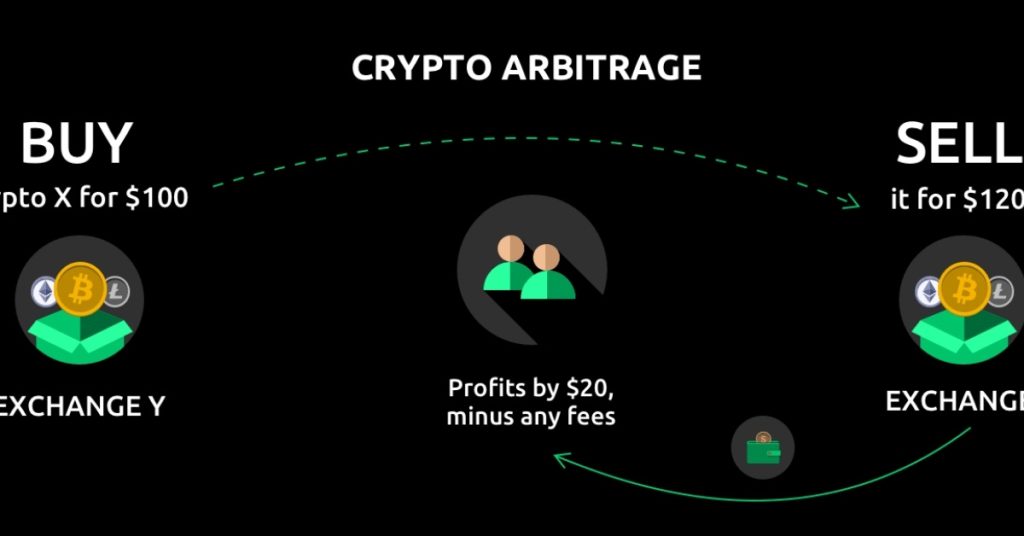
- Cryptocurrency markets operate around the clock, and the same digital asset can sometimes trade at different prices across exchange platforms. crypto arbitrage seeks to capitalize on these temporary price differences by buying an asset where it is cheaper and selling it where the price is higher. The strategy can involve simple cross-exchange trades, triangular trading pairs, or more advanced statistical models. While the concept sounds straightforward, profitable execution depends on liquidity, trading fees, spreads, slippage, transaction speed, and exchange reliability. Automated trading bots can help monitor markets and identify opportunities quickly, but arbitrage is not risk-free. Understanding market structure, costs, technology, and risk management is essential before committing capital.
Key takeaways
Cryptocurrency arbitrage is based on a simple market principle: when an identical or closely related asset has different prices in different markets, a trader may potentially profit by buying at the lower price and selling at the higher price.
The opportunity exists because cryptocurrency markets are decentralized, fragmented, global, and continuously active. Unlike traditional financial markets that may have more centralized structures and coordinated pricing mechanisms, crypto trading occurs across numerous independent cryptocurrency exchanges.
The most important points to understand are:
- Price differences: The same digital asset can temporarily have different prices on separate exchange platforms.
- 24/7 trading: Cryptocurrency markets remain open continuously across global exchanges, creating opportunities at different times.
- Simple arbitrage: Traders buy an asset on one exchange and sell it on another.
- Triangular arbitrage: Traders exploit pricing differences among three trading pairs on the same exchange.
- Statistical arbitrage: Traders use quantitative models to identify relationships that may temporarily become inefficient.
- Liquidity matters: A displayed price difference does not automatically represent a profitable opportunity if there is insufficient trading volume.
- Transaction fees matter: Trading fees, withdrawal fees, network costs, spreads, and slippage can eliminate an apparent profit.
- Automation can help: A trading bot or price monitoring bots can identify opportunities faster than manual monitoring.
- Risk remains: Transfers can be delayed, exchanges can experience outages, and prices can change before trades are completed.
- Legal and regulatory rules vary: Traders need to understand the laws, tax requirements, and exchange rules applicable to their location.
The central idea is straightforward, but profitable arbitrage requires much more than spotting two different prices. Execution speed, capital allocation, technology, liquidity, and risk controls determine whether an apparent opportunity is actually worthwhile.
What is arbitrage in cryptocurrency?
Arbitrage is a trading technique based on exploiting temporary differences in the price of the same or closely related asset in different markets. The concept is not unique to cryptocurrency. Arbitrage has long existed in traditional financial markets involving stocks, currencies, commodities, bonds, and other instruments.
In cryptocurrency markets, the concept becomes particularly relevant because digital asset trading is distributed among many independent cryptocurrency exchanges. Each exchange has its own users, order book, liquidity conditions, market makers, fees, and trading activity. These factors can cause prices to move slightly out of sync.
For example, imagine Bitcoin is trading at $60,000 on one exchange while the same Bitcoin is trading at $60,100 on another. In theory, the $100 difference represents a potential arbitrage spread.
A simplified process would look like this:
- Buy Bitcoin at $60,000 on the lower-priced exchange.
- Sell Bitcoin at $60,100 on the higher-priced exchange.
- Calculate the gross difference of $100.
- Subtract transaction fees, network costs, trading spreads, withdrawal costs, and possible slippage.
- Determine whether the remaining amount represents a meaningful net profit.
The critical word is potential. A $100 price difference does not automatically mean a trader can earn $100.
Suppose the exchange with the lower price has limited liquidity. The first Bitcoin may be available at $60,000, but the next portion could cost $60,050 or more. At the other exchange, the highest buying order might disappear before the sale is completed.
This is why arbitrage depends heavily on market efficiency, execution speed, liquidity, and access to capital.
Cryptocurrency arbitrage can also involve spatial arbitrage, where the same asset has different prices in geographically separated markets. This can overlap with cross-exchange arbitrage or cross-border arbitrage, particularly when regional demand, currency conversion, regulations, or capital controls influence prices.
The underlying principle remains the same: identify an inefficiency, execute the required transactions, and capture the difference before the market corrects it.
Why traders use cryptocurrency arbitrage
The primary attraction of cryptocurrency arbitrage is that it does not require a trader to make a conventional prediction about the future direction of an asset.
A directional trader may buy Bitcoin because they expect its price to rise. If Bitcoin falls instead, the position can lose money. Arbitrage has a different objective. The trader attempts to exploit a pricing difference that already exists between markets or trading pairs.
This distinction can make arbitrage appealing to experienced cryptocurrency traders who understand market structure and execution.
Several factors contribute to arbitrage opportunities.
Fragmented cryptocurrency markets
There is no single global order book that determines one universal price for every cryptocurrency. Different cryptocurrency exchanges operate their own markets.
An asset’s price can therefore vary slightly according to:
- Trading volume
- Available liquidity
- Market participants
- Regional demand
- Exchange-specific order books
- Fiat currency differences
- Market-making activity
- Temporary technical issues
- Network congestion
Most price differences are short-lived because traders and automated systems attempt to exploit them. As more participants buy the cheaper asset and sell the more expensive one, the difference generally narrows.
High cryptocurrency volatility
Volatility creates both risks and opportunities. Rapid price movement can cause exchanges to temporarily move out of alignment.
A sudden Bitcoin move, for example, might be reflected almost immediately on a highly liquid exchange while another platform updates slightly more slowly. That short period can create an arbitrage opportunity.
However, volatility can also turn arbitrage into a loss if execution is delayed.
24/7 market access
Cryptocurrency markets operate 24/7, unlike many traditional financial markets that have defined trading sessions.
This continuous operation means price differences can emerge at any time. Traders do not need to wait for a stock exchange to open before monitoring crypto markets.
At the same time, continuous trading means opportunities can appear and disappear while a trader is asleep. This is one reason automated price monitoring bots and trading systems are widely used in sophisticated arbitrage strategies.
Liquidity differences
Liquidity determines how easily an asset can be bought or sold without significantly affecting its price.
An exchange may show an attractive Bitcoin price, but if only a small amount is available at that level, a large order may receive a much worse average execution price.
Therefore, professional arbitrage analysis considers the entire order book rather than looking only at the headline price.
Is crypto arbitrage legal?
Crypto arbitrage is generally a trading activity rather than an inherently illegal strategy, but its legal and regulatory treatment depends on the jurisdiction, assets involved, exchanges used, and applicable financial rules.
Traders should distinguish between using an arbitrage strategy and violating rules while executing it. An exchange may prohibit certain forms of market manipulation, deceptive trading, abusive API activity, or other conduct regardless of whether the trader describes the strategy as arbitrage.
Tax treatment can also vary. Profits from buying and selling digital assets may create reporting or tax obligations depending on the trader’s jurisdiction.
Before committing investment capital, traders should therefore:
- Review local cryptocurrency regulations.
- Understand applicable tax rules.
- Read each exchange’s terms of service.
- Verify identity and account requirements.
- Check restrictions on deposits and withdrawals.
- Understand rules governing automated trading.
- Keep accurate records of transactions and fees.
Legal compliance is especially important when using cross-border arbitrage because different countries may impose different requirements on exchanges, digital assets, currency transfers, and taxation.
Cryptocurrency arbitrage strategy types
Cryptocurrency arbitrage is not one single technique. Traders use several approaches depending on their capital, technical capabilities, exchange access, and tolerance for execution risk.
The following strategies represent some of the most common forms.
Simple arbitrage
Simple arbitrage is the easiest strategy to understand.
A trader identifies the same cryptocurrency trading at different prices on two exchange platforms. The trader buys on the cheaper exchange and sells on the more expensive exchange.
For example:
Exchange Bitcoin Price Action Exchange A $60,000 Buy Exchange B $60,100 Sell Gross difference $100 Potential spread The table illustrates the basic concept, not a guaranteed $100 profit. Trading fees, spreads, network fees, withdrawal charges, taxes, and slippage must all be deducted before calculating the actual return.
Simple arbitrage is sometimes called spatial arbitrage because the price difference exists between separate marketplaces. When it specifically involves different cryptocurrency exchanges, it can also be described as cross-exchange arbitrage.
One practical challenge is moving funds between exchanges. A trader may need to transfer cryptocurrency from one platform to another, but blockchain confirmation times and network congestion can make this risky.
For that reason, experienced traders may maintain balances on multiple exchanges. Instead of transferring funds after every opportunity, they can buy with capital already available on the cheaper exchange and sell using capital already positioned on the more expensive exchange.
This approach can improve execution speed but requires more investment capital and introduces additional exchange-counterparty risk.
Triangular arbitrage
Triangular arbitrage involves three trading pairs rather than two exchanges.
The trader attempts to exploit inconsistencies among three related assets or currency pairs.
A simplified example might involve:
- Bitcoin
- Ethereum
- A stablecoin or fiat currency
The trader begins with one asset, converts it into the second asset, converts the second into the third, and finally converts the third back into the original asset.
For example, a theoretical sequence could be:
USDT → BTC → ETH → USDT
If the exchange rates are temporarily inconsistent, the final USDT balance may be greater than the starting amount after accounting for trading costs.
Triangular arbitrage can be attractive because it does not necessarily require moving funds between exchanges. However, it requires extremely fast calculations and execution.
Each trade generates a new source of risk. If the first transaction changes the available price before the second or third transaction executes, the expected opportunity can disappear.
This is why triangular arbitrage is often associated with automation. A computer system can continuously calculate potential routes and compare expected returns against fees and minimum profit thresholds.
Statistical arbitrage
Statistical arbitrage uses quantitative analysis to identify historical or mathematical relationships that may temporarily become inefficient.
Rather than simply looking for an obvious price difference, a statistical arbitrage system may analyze correlations, price spreads, volatility, trading volume, and other market variables.
For example, two cryptocurrencies might historically move in a relatively consistent relationship. If that relationship becomes unusually wide, a quantitative strategy could identify the divergence as a potential opportunity.
Unlike simple arbitrage, statistical arbitrage does not always provide a guaranteed convergence. Historical relationships can break down.
Advanced systems may use machine learning algorithms to analyze large amounts of market data and identify patterns. However, machine learning does not remove market risk. A model can be wrong, overfit historical data, or fail when market conditions change.
Statistical arbitrage therefore requires strong knowledge of probability, statistics, data analysis, risk management, and programming.
Arbitrage trading in cryptocurrency: Careers and skills
Arbitrage trading can also connect with several careers in finance and technology.
A professional cryptocurrency trader needs to understand order books, market liquidity, execution, risk management, and digital asset markets. A financial analyst may focus more heavily on financial data, valuation, market trends, and quantitative analysis.
Technical roles can involve programming, cryptography, blockchain systems, data engineering, and software engineering.
Useful skills include:
- Financial market fundamentals
- Cryptocurrency market structure
- Quantitative analysis
- Statistics and probability
- Programming
- API integration
- Data analysis
- Blockchain fundamentals
- Cryptography basics
- Risk management
- Algorithmic trading
- Database management
- Cybersecurity awareness
Someone interested in automated arbitrage may need to build or manage systems that collect real-time prices from multiple cryptocurrency exchanges. These systems must handle API limitations, authentication, error recovery, latency, and security.
Education can help develop these capabilities. Technology-focused programs such as the Microsoft AI & ML Engineering Professional Certificate and IBM Generative AI Fundamentals can provide broader technical foundations, while platforms offering Coursera Plus can provide access to multiple learning programs.
The LinkedIn newsletter Career Chat can also be useful for people researching professional development and technology-related career paths.
However, education alone does not make someone a profitable arbitrage trader. Practical market experience, disciplined risk management, and technical reliability remain essential.
How to trade arbitrage cryptocurrency
Trading arbitrage cryptocurrency manually is possible, but finding opportunities consistently becomes difficult as market conditions change rapidly.
Read More : How to Store Bitcoin Securely: Safest Methods Explained
A practical workflow starts with identifying multiple reputable exchange platforms and comparing their order books.
Step 1: Select suitable exchanges
Choose cryptocurrency exchanges that support the assets and trading pairs you need.
Check:
- Trading fees
- Withdrawal fees
- Deposit methods
- Supported cryptocurrencies
- Liquidity
- API availability
- Withdrawal limits
- Security practices
- Regional availability
Do not select an exchange solely because it displays a higher price. Reliability is part of the opportunity calculation.
Step 2: Compare real executable prices
Do not rely only on a displayed last-traded price.
Instead, examine the actual bid and ask prices and the amount available at each level.
For example, if Bitcoin is shown at $60,000 on one platform, determine how much Bitcoin can actually be purchased at or near that price.
The same applies when selling. A theoretical $100 difference is irrelevant if the order book cannot support the required trade size.
Step 3: Calculate the complete cost
Before executing, calculate:
Net profit = selling proceeds − purchase cost − trading fees − withdrawal costs − network fees − slippage − other applicable costs
This calculation is essential.
A price difference may look attractive but become unprofitable after transaction fees. Smaller spreads are particularly vulnerable to costs.
Step 4: Decide whether funds should be pre-positioned
One method of reducing transfer delays is maintaining funds on multiple exchanges.
For example, a trader might hold part of a cryptocurrency portfolio and stablecoin balances on two or more platforms.
When an opportunity appears, the trader can execute both sides without waiting for a blockchain transfer.
The disadvantage is that funds are exposed to multiple exchange platforms rather than one. Traders must therefore consider counterparty risk and operational security.
Step 5: Consider automation
Manual arbitrage becomes challenging when opportunities last only seconds.
A trading bot can monitor prices continuously and execute predefined instructions when certain conditions are met.
Price monitoring bots can compare multiple markets and alert users when spreads reach a chosen threshold.
Platforms such as Coinrule, Cryptohopper, and Bitsgap are examples of tools associated with automated cryptocurrency trading. Bitsgap, for example, has supported connectivity across over 16 cryptocurrency exchanges, illustrating how multi-exchange automation can work.
CoinMarketCap can also be useful for monitoring cryptocurrency prices, market capitalization, trading volume, and broader market information.
However, automated tools are not guaranteed-profit systems. Users must understand their configurations, permissions, exchange API access, and risk controls before allowing software to trade with real funds.
Step 6: Start with controlled capital
New traders should avoid committing a large amount of investment capital immediately.
A sensible progression is:
- Learn how the exchanges work.
- Compare prices manually.
- Calculate net spreads.
- Test with small amounts.
- Evaluate execution results.
- Identify recurring costs and failures.
- Introduce automation only after understanding the process.
- Increase capital gradually if the strategy remains viable.
The goal is not to execute the highest number of trades. The goal is to execute trades where the expected net return justifies the operational and market risks.
Step 7: Monitor risks continuously
Arbitrage can fail for reasons unrelated to the original price difference.
Common risks include:
- Exchange outages
- Withdrawal delays
- Blockchain congestion
- API failures
- Sudden volatility
- Insufficient liquidity
- Incorrect bot configuration
- Account restrictions
- Security breaches
- Stablecoin price deviations
- Unexpected transaction fees
- Slippage
Crypto wallets also require careful management. Traders should understand how funds move between exchanges and wallets and should use appropriate security practices.
Finally, arbitrage should not be confused with risk-free investing. The apparent price inefficiency may disappear before the trade is completed, and the cost of correcting an unsuccessful trade can exceed the expected profit.
Stay up-to-date with cryptocurrency topics using our free resources
Cryptocurrency markets change quickly, so traders benefit from continuously improving their knowledge.
Important areas include blockchain technology, cryptocurrency exchanges, digital asset security, trading strategies, portfolio management, market structure, and financial regulation.
Read More : Bitcoin Transaction Explained Simply: How It Really Work
- Beginners can start with foundational subjects such as How to Buy Cryptocurrency, cryptocurrency portfolio management, blockchain fundamentals, and basic trading concepts.
People interested in technical careers can also study programming, machine learning, software engineering, data analysis, and cryptography. These skills are increasingly relevant to algorithmic trading and financial technology.
New course! Learn how to build apps without coding.
No-code development can help beginners understand how digital applications are designed without requiring advanced programming skills from the beginning.
Although building an arbitrage trading system generally requires more advanced technical capabilities, learning how applications work can provide useful foundational knowledge.
A learner can progress from no-code concepts toward:
- APIs
- Databases
- Automation
- Programming
- Data processing
- Machine learning
- Blockchain development
The broader objective should be developing skills that remain useful beyond one specific cryptocurrency strategy.
Learning resources and professional certificates can be particularly valuable when combined with practical projects. For example, someone interested in combining finance and technology might study market data analysis alongside programming and blockchain fundamentals.
The cryptocurrency industry Changes Rapidly, so continuous learning is often more valuable than relying on a single strategy indefinitely.
Asked Questions (FAQs)
Is cryptocurrency arbitrage profitable?
Cryptocurrency arbitrage can be profitable when price differences are large enough to cover trading fees, spreads, transaction costs, slippage, and other expenses. However, profitability is not guaranteed. Competition from professional traders and automated systems can reduce opportunities quickly.
Is crypto arbitrage risk-free?
No. Arbitrage is sometimes described as lower-directional-risk trading, but it is not risk-free. Exchange failures, price changes, liquidity shortages, transfer delays, technical problems, and regulatory issues can produce losses.
How much money do I need for crypto arbitrage?
There is no universal minimum. The required amount depends on the strategy, exchange fees, asset prices, minimum order sizes, and expected spread. Very small capital may produce profits too small to justify transaction costs, while larger capital creates greater exposure to operational and market risks.
Can I perform crypto arbitrage manually?
Yes. A trader can manually compare prices across cryptocurrency exchanges and execute trades. Manual execution is generally easier for learning but becomes difficult when opportunities are extremely short-lived.
What is cross-exchange arbitrage?
Cross-exchange arbitrage involves buying a digital asset on one cryptocurrency exchange at a lower price and selling it on another exchange at a higher price. It is one of the most straightforward forms of cryptocurrency arbitrage.
What is triangular arbitrage?
Triangular arbitrage involves three trading pairs, usually on the same exchange. The trader attempts to profit from inconsistencies in the exchange rates between the three assets.
Are trading bots necessary?
No. Bots are not required, but they can help monitor multiple markets and respond faster than a human. Tools such as Coinrule, Cryptohopper, and Bitsgap can automate certain trading functions, although users remain responsible for configuration and risk management.
Does Bitcoin work well for arbitrage?
Bitcoin is frequently used in arbitrage because it has extensive global trading activity and is available across many cryptocurrency exchanges. However, its high liquidity can also mean that pricing differences are corrected quickly.
What role does liquidity play?
Liquidity determines how much of an asset can be bought or sold without substantially moving its price. A large advertised spread may be useless if the available trading volume is too small to execute the desired transaction.
What are the biggest costs?
Common costs include transaction fees, exchange trading fees, withdrawal charges, blockchain network fees, spreads, and slippage. These expenses must be included when calculating expected net profit.
Can arbitrage work across countries?
Yes, cross-border arbitrage can occur when regional markets show different prices. However, currency conversion, regulations, taxes, banking restrictions, transfer times, and exchange availability can make cross-border strategies more complicated.
Is arbitrage better than directional trading?
Neither approach is universally better. Arbitrage focuses on pricing inefficiencies, while directional trading attempts to profit from anticipated market movement. Each has different risks, costs, skills, and execution requirements.
Final Words
Cryptocurrency arbitrage is a trading strategy that seeks to profit from temporary price differences for the same digital asset across cryptocurrency exchanges or trading pairs. Traders may use simple, cross-exchange, triangular, spatial, cross-border, or statistical arbitrage strategies. Unlike directional trading, arbitrage focuses on market inefficiencies rather than predicting whether prices will rise or fall. Bitcoin and other digital assets can experience price differences because cryptocurrency markets are decentralized, fragmented, volatile, and active 24/7.
Successful arbitrage requires careful attention to liquidity, transaction fees, spreads, slippage, transfer delays, and exchange reliability. Trading bots and price monitoring tools can improve speed and efficiency, but they cannot eliminate risk. Traders should understand regulations, security, capital requirements, and technology before using real funds.
ypto Arbitrage: How Does It Work and Make Money