
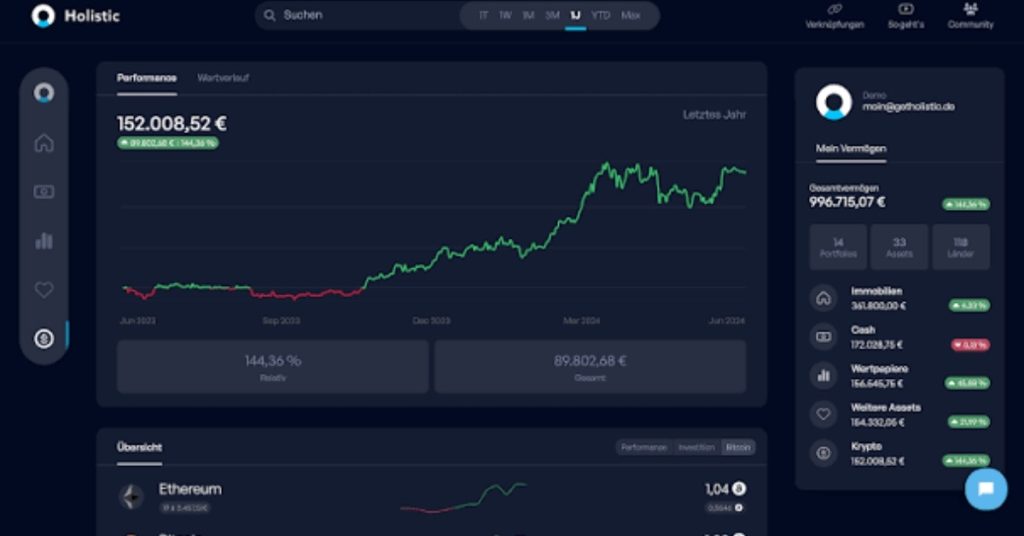
A crypto portfolio is more than a collection of digital coins; it is a structured way to manage cryptocurrency exposure according to your goals, risk tolerance, and investment strategy. A well-planned portfolio can combine established assets such as Bitcoin and Ethereum with selected altcoins, stablecoins, and higher-risk opportunities. The key is balancing potential growth with the volatility that defines crypto markets. Diversification can reduce dependence on one asset, while Dollar-Cost Averaging (DCA), regular rebalancing, and careful coin selection can support disciplined decisions. Investors should also understand market cycles, tokenomics, market capitalization, and project fundamentals before buying. Clear price targets and an exit strategy can further help limit emotional decisions during rapidly changing market conditions.
What is a crypto portfolio?
A crypto portfolio is the complete collection of cryptocurrencies and related digital assets owned or managed by an investor. It can contain one asset or dozens of assets, although simply owning many cryptocurrencies does not automatically make a portfolio diversified.
For example, an investor might hold Bitcoin as the core asset, Ethereum for exposure to smart-contract applications, Solana for a different blockchain ecosystem, and USDC as a stablecoin reserve. Another investor might include Ripple, Litecoin, Dogecoin, Cosmos, BONK, or other altcoins. The appropriate combination depends on the investor’s objectives and risk tolerance.
The basic purpose of portfolio construction is to determine what to own, how much to own, and when to change those allocations. This makes a crypto portfolio different from simply purchasing coins whenever their prices increase.
Cryptocurrencies can experience substantial volatility. A portfolio containing several highly correlated altcoins may fall sharply during a market correction even though it contains many individual assets. Effective diversification therefore requires looking beyond the number of coins held.
Investors may categorize their holdings into different roles:
- Core assets: Usually larger, established cryptocurrencies such as Bitcoin and Ethereum.
- Growth assets: Smaller cryptocurrencies with potentially higher growth but greater risk.
- Stablecoins: Assets such as USDC designed to maintain a relatively stable value.
- DeFi tokens: Tokens connected with decentralized finance protocols.
- Memecoins: Speculative assets such as Dogecoin or BONK that can experience extreme price movements.
- Cash-like reserves: Stablecoins or uninvested capital kept available for future opportunities.
A portfolio can also be built around market capitalization. Some investors focus primarily on the Top 2 cryptocurrencies, while others spread exposure across the Top 20 or Top 25 assets. These categories can change over time, so market capitalization should be treated as a measurement rather than a guarantee of quality.
Key Takeaways
- A crypto portfolio contains one or more cryptocurrencies and digital assets.
- Diversification can reduce dependence on a single cryptocurrency.
- Bitcoin and Ethereum can serve as core holdings in some investment strategies.
- Altcoins and memecoins generally require greater attention to risk and volatility.
- Stablecoins can provide liquidity but are not completely risk-free.
- Dollar-Cost Averaging (DCA) can reduce the pressure of trying to time the market.
- Rebalancing helps keep portfolio allocations aligned with an investment plan.
- DYOR (Do Your Own Research) is essential before purchasing unfamiliar tokens.
- Price targets and an exit strategy can reduce emotional decision-making.
- No portfolio structure can eliminate cryptocurrency investment risk.
Why you need a diversified crypto portfolio
Diversification is one of the most important concepts in portfolio management. The idea is straightforward: instead of relying entirely on the performance of one asset, capital is distributed across multiple investments with different characteristics.
Cryptocurrency markets can move rapidly because they are influenced by adoption, liquidity, regulation, technology, investor sentiment, macroeconomic conditions, and market cycles. Bitcoin may rise while certain altcoins decline. Ethereum may outperform during one period while another blockchain ecosystem attracts more attention during a different period.
A diversified portfolio can therefore provide multiple sources of potential returns while reducing concentration risk.
Consider an example portfolio containing 65% Bitcoin, 20% Ethereum, 10% smaller altcoins, and 5% stablecoins. Bitcoin represents the largest allocation, while Ethereum provides additional exposure to blockchain applications. Smaller altcoins provide higher-risk growth exposure, and the stablecoin allocation provides liquidity.
This is only an example, not a universal formula. Someone with a low risk tolerance might prefer a much larger allocation to established assets, while an aggressive investor may accept greater exposure to smaller cryptocurrencies.
Diversification should also consider correlation. Holding Bitcoin, Ethereum, and five different altcoins may look diversified on paper, but many crypto assets can move in the same direction during periods of market stress.
The same principle applies when comparing cryptocurrencies with traditional assets. Stocks, ETFs, and commodities can behave differently from digital assets and may therefore provide broader portfolio diversification for investors whose overall financial plan permits it. Derivatives can also provide market exposure, but their complexity and risk make them unsuitable for every investor.
Diversification is not designed to maximize returns at all times. Its primary purpose is to create a portfolio that an investor can realistically maintain through both bull markets and bear markets.
Strategies for building a crypto portfolio
Building a portfolio starts with deciding how much risk you are prepared to accept. Risk tolerance should come before coin selection because the most attractive cryptocurrency is not necessarily the right asset for every investor.
A useful investment strategy begins by defining a few basic parameters:
- Determine the amount of capital you can afford to expose to cryptocurrency.
- Decide whether your objective is long-term growth, shorter-term trading, or a combination.
- Establish your risk tolerance and expected investment horizon.
- Define a target allocation for different asset categories.
- Research individual cryptocurrencies before buying them.
- Decide how often the portfolio will be reviewed and rebalanced.
The next step is research. DYOR (Do Your Own Research) means evaluating an asset independently rather than purchasing it because someone on social media recommended it.
Fundamental analysis can include studying the project’s technology, development activity, adoption, competition, leadership, roadmap, tokenomics, market capitalization, and real-world use cases. Technical analysis, meanwhile, focuses on price behavior, trends, support and resistance levels, volume, and indicators.
Some traders monitor the 50-day moving average and 200-day moving average to understand longer-term trends. A golden cross, where a shorter-term moving average moves above a longer-term moving average, is commonly interpreted as a potentially positive technical signal. A death cross, where the shorter-term average moves below the longer-term average, is often viewed as a bearish signal.
These indicators should not be treated as guaranteed predictions. Crypto markets can produce false signals, especially during periods of extreme volatility.
Strategies for beginners:
Beginners generally benefit from simplicity. Owning too many cryptocurrencies can make it difficult to understand what is happening inside the portfolio.
A straightforward approach may focus on established assets first and gradually introduce higher-risk investments after gaining experience.
One possible framework is:
- Establish a core allocation around established cryptocurrencies.
- Keep speculative altcoins to a smaller portion of the portfolio.
- Avoid investing money needed for essential expenses.
- Use Dollar-Cost Averaging (DCA) instead of attempting to predict every short-term market movement.
- Maintain a written investment strategy.
- Review the portfolio periodically instead of reacting to every price change.
- Learn about trading fees before making frequent transactions.
Dollar-Cost Averaging means investing a predetermined amount at regular intervals regardless of short-term price movements. For example, an investor might purchase a fixed amount of Bitcoin every week or month.
DCA does not guarantee a profit or prevent losses. Its main advantage is behavioral: it reduces the temptation to make a large emotional purchase after a sharp rally.
Beginners should also be careful with FOMO and FUD. FOMO, or fear of missing out, can encourage investors to buy after prices have already surged. FUD, meaning fear, uncertainty, and doubt, can encourage panic selling during temporary declines.
A beginner should also understand that stablecoins are not identical to cash held in a bank. They have their own issuer, reserve, regulatory, operational, and market risks.
Strategies for experienced investors:
Experienced investors may use more advanced portfolio structures because they generally have a better understanding of volatility, market cycles, liquidity, and portfolio risk.
An experienced strategy might combine:
- Core Bitcoin and Ethereum exposure.
- Selective altcoin positions.
- DeFi tokens based on researched protocols.
- Smaller allocations to memecoins.
- Stablecoin reserves.
- Limit orders for predetermined entry or exit levels.
- Technical analysis for market timing.
- Fundamental analysis for long-term coin selection.
- Regular rebalancing.
- Defined price targets and exit strategy rules.
Some investors may also explore automated investing services such as Auto Invest, depending on the platform and jurisdiction. Automated purchases can make DCA easier to follow, but investors should understand fees and asset selection before enabling an automated system.
For example, a platform such as Finst may offer portfolio-related features, but investors should independently check its current products, fees, availability, and regulatory status before using any service.
Read More : Bitcoin Transaction Explained Simply: How It Works
Trading fees can have a meaningful effect on active strategies. A 0.15% trading fee may appear small on one transaction, but repeated buying and selling can make those costs significant over time.
Limit orders can help traders specify the price at which they want to buy or sell rather than automatically accepting the current market price. However, a limit order may remain unfilled if the market never reaches the specified level.
Experienced investors should also distinguish between investing and speculation. A small BONK or other memecoin position may be acceptable within a defined risk budget, but allowing speculative assets to dominate the portfolio can dramatically change its overall risk profile.
Building your crypto portfolio
Once an investment strategy has been defined, the portfolio can be constructed around clear allocation categories rather than individual coins selected randomly.
A useful starting point is to divide the portfolio into core, growth, speculative, and liquidity components.
For example, an illustrative portfolio could allocate 60% to Bitcoin, with the remaining 40% distributed across Ethereum, selected altcoins, and stablecoins. Another example could use 65% Bitcoin, 20% Ethereum, 10% smaller altcoins, and 5% stablecoins.
These figures are examples rather than recommendations. The correct allocation depends on financial circumstances, risk tolerance, time horizon, and investment objectives.
| Portfolio Component | Example Role | Main Consideration |
| Bitcoin | Core exposure | Established but still volatile |
| Ethereum | Smart-contract exposure | Ecosystem and network activity |
| Altcoins | Growth exposure | Higher volatility and project risk |
| DeFi tokens | Decentralized finance exposure | Protocol and smart-contract risk |
| Memecoins | Speculative exposure | Extremely high volatility |
| Stablecoins | Liquidity reserve | Issuer and operational risks |
When to part with your crypto portfolio?
Selling cryptocurrency can be harder than buying it because investors often become emotionally attached to positions that have performed well. A clear exit strategy can make the process more disciplined.
There is no universal signal that tells every investor when to sell. Instead, the decision should be connected to the reason the cryptocurrency was purchased in the first place.
A strong portfolio management process considers both planned exits and unexpected changes. A project may experience a major security problem, lose user adoption, change its tokenomics, miss important development milestones, or face regulatory challenges. In such cases, the original investment thesis may no longer be valid.
Market cycles also matter. Bull markets can encourage excessive optimism, while bear markets can create fear and pessimism. Neither emotion should automatically determine an investment decision.
1. Set price targets
Price targets can provide a predetermined framework for taking profits or reducing exposure.
For example, an investor could decide before purchasing an asset that a specific percentage will be sold after a particular price increase. Instead of attempting to identify the exact market top, the investor gradually reduces exposure according to predefined rules.
This approach can help control FOMO during rapid rallies.
Price targets should not be treated as guarantees. Cryptocurrency prices can overshoot expectations in either direction, and market conditions can change quickly.
An investor can also use percentage-based targets rather than trying to predict one exact price. For example, a portfolio manager might sell a portion after a substantial gain, another portion at a higher level, and retain a smaller position for longer-term exposure.
The important point is to establish the rules before emotions become intense.
2. Recognize market cycles
Crypto markets have historically moved through periods commonly described as accumulation, expansion, euphoria, correction, and decline. These phases are often grouped into broader bull markets and bear markets.
Market cycles are difficult to time precisely. Investors who attempt to sell at the exact peak and buy at the exact bottom can easily make decisions based on hindsight rather than reliable evidence.
Technical analysis can provide additional context. Traders may monitor trend structure, volume, moving averages, momentum, and support or resistance levels. The 50-day moving average and 200-day moving average are among the indicators commonly watched by market participants.
Fundamental signals can also matter. Changes in network activity, developer adoption, regulation, liquidity, token supply, and project fundamentals may affect the long-term outlook.
A market correction does not automatically mean that an asset should be sold. Likewise, a rising price does not automatically mean that fundamentals have improved.
The goal is to distinguish normal volatility from a genuine change in the investment thesis.
3. Reassess your goals
An investment that was appropriate two years ago may not fit your circumstances today.
Your financial goals, risk tolerance, income, investment horizon, and need for liquidity can all change. A crypto portfolio should therefore be reviewed alongside your broader financial situation.
Read More : Crypto Market Analysis: How Cryptocurrency Markets Work
Reassessing goals can a nswer several important questions:
- Is the portfolio still consistent with my risk tolerance?
- Has one cryptocurrency become too large a percentage of my holdings?
- Has the original investment thesis changed?
- Do I still understand the assets I own?
- Am I holding because of research or simply because I hope prices recover?
- Do I need the capital for another financial goal?
- Has my preferred investment strategy changed?
HODL can be a reasonable approach when it is based on a long-term thesis, but holding indefinitely should not become an excuse for ignoring fundamental changes.
The same applies to smaller altcoins and memecoins. A position that began as a small speculative allocation can become disproportionately large after a major price increase. Rebalancing can help bring it back within the intended risk limit.
Final thoughts
A balanced crypto portfolio is less about finding the perfect cryptocurrency and more about managing risk with consistency. Bitcoin, Ethereum, Solana, Ripple, Litecoin, Dogecoin, Cosmos, BONK, and other cryptocurrencies all have different characteristics, use cases, market capitalizations, and risk profiles.
The strongest portfolio is therefore not necessarily the one containing the largest number of coins. It is the one whose structure matches the investor’s objectives and ability to tolerate losses.
Diversification can reduce concentration risk, while DCA can create a more systematic buying process. Fundamental analysis and technical analysis can provide different forms of market insight. Rebalancing can prevent a successful position from quietly becoming an oversized risk.
Most importantly, investors should have a reason for owning every asset. If the reason is unclear, the position deserves another review.
Cryptocurrency remains highly volatile, and even well-researched investments can lose substantial value. A disciplined investment strategy cannot remove that risk, but it can help investors make decisions based on predefined rules rather than FOMO, FUD, or short-term market excitement.
Readers of this article are also interested in
Readers building a cryptocurrency investment strategy may also benefit from learning about related topics such as cryptocurrency market analysis, crypto risk management, Dollar-Cost Averaging, diversification, rebalancing, technical analysis, Fundamental Analysis, stablecoins, altcoins, DeFi, blockchain technology, and market cycles.
Understanding these subjects together can create a stronger foundation for portfolio management. For example, risk management explains how much capital should be exposed, while market analysis can help investors understand changing conditions. Tokenomics and fundamental research can then help with individual coin selection.
Asked Questions (FAQs)
What is a crypto portfolio?
A crypto portfolio is a collection of cryptocurrencies and digital assets owned by an investor. It can contain Bitcoin, Ethereum, altcoins, stablecoins, DeFi tokens, memecoins, or other blockchain-based assets.
How many cryptocurrencies should a portfolio contain?
There is no universal number. A portfolio containing five carefully researched assets may be more diversified than one containing 30 highly correlated cryptocurrencies. Quality, allocation, correlation, liquidity, and risk matter more than the raw number of holdings.
Is Bitcoin enough for a crypto portfolio?
Bitcoin can serve as the primary or only cryptocurrency holding for an investor who prefers simplicity, but it does not eliminate cryptocurrency-specific risk. Whether additional assets are appropriate depends on the investor’s objectives and risk tolerance.
Should beginners buy altcoins?
Beginners can research altcoins, but smaller cryptocurrencies generally carry greater volatility and project risk. Anyone considering them should understand the project, tokenomics, market capitalization, liquidity, roadmap, and potential risks before investing.
What is Dollar-Cost Averaging?
Dollar-Cost Averaging is a strategy where an investor purchases a predetermined amount of an asset at regular intervals. It reduces reliance on predicting the perfect entry point but does not guarantee profits.
How often should I rebalance my crypto portfolio?
The appropriate schedule depends on the investment strategy. Some investors review allocations monthly or quarterly, while others rebalance only after an allocation moves substantially away from its target. The key is having a consistent rule rather than reacting to every daily price movement.
Are stablecoins safe?
Stablecoins are designed to maintain relatively stable prices, but they still involve risks. These can include issuer, reserve, liquidity, regulatory, technological, and operational risks. Investors should understand how a particular stablecoin maintains its value.
What is the difference between fundamental and technical analysis?
Fundamental analysis evaluates factors such as technology, adoption, tokenomics, development, competition, and project fundamentals. Technical analysis studies price behavior, trends, volume, and indicators such as moving averages.
What is an exit strategy in crypto?
An exit strategy is a predefined plan for reducing or closing a cryptocurrency position. It may use price targets, percentage-based profit taking, changes in fundamentals, portfolio allocation limits, or changes in an investor’s financial goals.
Should I hold crypto during a bear market?
There is no universal answer. The appropriate decision depends on why the asset was purchased, whether the original investment thesis remains valid, and the investor’s risk tolerance. A bear market can test a portfolio’s risk management and investment strategy.
What are crypto bundles?
Crypto bundles are grouped collections of cryptocurrencies offered as a single investment product or portfolio strategy. They can simplify diversification, but investors should examine the underlying assets, weighting methodology, fees, rebalancing rules, and risks before using them.
Final Words
A crypto portfolio is a collection of digital assets managed according to an investor’s goals, risk tolerance, and investment strategy. Building a balanced portfolio involves diversification across assets such as Bitcoin, Ethereum, altcoins, DeFi tokens, stablecoins, and carefully limited speculative investments. Strategies including Dollar-Cost Averaging, fundamental analysis, technical analysis, and regular rebalancing can help investors manage volatility and maintain their intended allocations. Understanding market capitalization, tokenomics, blockchain technology, market cycles, and trading costs is also important for informed decision-making.
Successful portfolio management also requires a clear exit strategy. Setting price targets, recognizing bull and bear markets, and regularly reassessing financial goals can help investors avoid emotional decisions driven by FOMO or FUD. No portfolio can eliminate cryptocurrency risk, but disciplined diversification, DYOR, and consistent risk management can create a more structured approach to navigating changing crypto markets.

